Tuesday, June 10, 2008

Rating system for IPTS - The Star

KOTA KINABALU: June 10, 2008

A rating system for private institutions of higher learning (IPTS) will be in place once all them have been audited.

Deputy Higher Education Minister Dr Hou Kok Chung said the ministry had started an “establishment audit” since last month of 200 IPTS, including 37 private universities and university colleges.

This, he said, was to ensure that their courses were of quality and followed various regulations.

He added that the exercise would see 120 institutions undergoing a full audit with officers going on the ground to check various facilities, while the remaining 80 would have to submit their details to the ministry.

“We will be looking at their staff, courses, student intake, examination process, management and financial capability among others,” Dr Hou told reporters yesterday after a meeting with senior executives of IPTS here.

This is the deputy minister's first meeting with senior executives of such institutions. The next will be in Penang on June 16.

According to Dr Hou, there were no immediate plans to give star ratings to IPTS as was being done for public universities under the Setara system, but it was the ministry's eventual goal to work along similar lines.

“This audit will help them improve their quality,” he said.

For instance, he pointed out, one area the ministry was focusing on was student intake as there had been complaints that IPTS had admitted students not qualified for certain courses.

To a question of students in rural areas of Sabah being cheated by some colleges, Dr Hou said the ministry would always check on advertisements by IPTS and act against those making dubious claims.

However, he urged parents to check the ministry’s websites for accredited colleges to avoid being cheated.

There are more than 500 IPTS in the country.

Monday, June 9, 2008

Proclaimation of OUM's New Chancellor

Dec 8, 2007

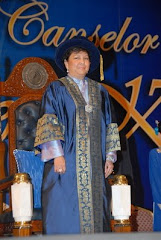
YAB Datin Seri Jeanne Abdullah, the wife of YAB the Prime Minister of Malaysia, was proclaimed as the new Chancellor of Open University Malaysia on December 8, 2007


Thursday, June 5, 2008

Space the next frontier for Internet - NST

Internet pioneer Dr Vinton Cerf also talks about a merging between TV and the Net.

KUALA LUMPUR: By Ridzwan A. Rahim

Space is the next frontier for the Internet, says Internet pioneer Dr Vinton Cerf.

The Google vice-president and chief Internet evangelist, revealed that he was working on the Interplanetary Internet, a project of the Nasa Jet Propulsion Lab that aims to extend the Internet into outer space for planet-to-planet communications.

"The project has been going on for about 10 years now and requires some significant development in the new protocols in addition to TCP/IP," he told the New Straits Times at the World Congress on Information Technology (WCIT), referring to the Internet's common language.

Those protocols, he said, were now stable and were being standardised in the Consultative Committee for Space Data System, a group of international space agencies working together to standardise communications in space.

The group will start doing space-based testing of the protocols at the end of this year using Nasa's Deep Impact spacecraft. This will be followed by testing on a space station which Cerf expects to take place next year.

"If those tests are successful, we will offer these protocols with no constraints whatsoever and hope that all the space agencies will use them.

"If they do, every mission launched, whether its manned or unmanned, will have the ability to communicate with each other."

Cerf is widely known as the "father of the Internet", although it is a title he rejects.

In 1969, while at University California, Los Angeles, Cerf and two fellow graduate students, Bob Kahn and Leonard Klienrock, took the first crucial step of hooking up a computer to a switch in a military-commissioned project known as Arpanet, the predecessor of the global Internet.

Decades later, a new set of protocols called DTN, which stands for Delay and Disruption Tolerance Networking, had to be invented in order to make interplanetary communications possible. It is different from TCP/IP.

"When we originally started this work, we thought we could use the standard Internet protocols but we quickly discovered that they wouldn't work very well.

"For one thing, it takes quite a long time for radio signals to propagate back and forth between the planets because the distances are so big. Between Earth and Mars, for example, the one-way propagation time at the speed of light is between three to 20 minutes.

"It's not like a phone call; when you say hello, the person on the other end cannot hear you say that for three minutes or maybe as much as 20 minutes - at the speed of light."

Cerf said the goal was not to "build a big interplanetary network and hope somebody will use it".

"It simply means that when I launch a mission, if there are previous assets from other missions, or my own, up there still, I can make use of them to support my mission. So in an interesting way, over time we will accumulate an interplanetary backbone of communication using the standard protocols."

Cerf also spoke of a merging between TV and the Internet. He said by 2035, through a technology called IPTV, it would be viable to deliver an hour's worth of TV content through the Internet in just 16 seconds.

"People are going to download the video and play it back whenever they want it, just like the iPod."

Internet Protocol Television will also open up an exciting new form of advertising that is not disruptive, unlike the commercials on conventional television.

In Cerf's version of IPTV, the images in the field of view can be sensitised so that if there is an item of interest, viewers can click on it and find out more about the item.

Calling it a "quite doable" technology, Cerf said conventional broadcast, cable and satellite TV would have to adapt to the idea of people wanting to download and play back their shows.

Wednesday, June 4, 2008

LYICT Conference - KL, Malaysia. July 7 - 10, 2008


IFIP education has a tradition of organising exciting conferences which stimulate discussion, foster the exchange of ideas and knowledge and generate more informed understanding of the issues of Informatics and ICT in education.

LYICT is a combination of two day Open Conference and a two day Working Conference focusing on aspects related to the following themes that are central to the work of Working Groups 3.1, 3.2 and 3.6:

* Development of informatics and ICT knowledge and practice in secondary and higher education,

* Various aspects of technology based learning and training with respect to related impact on policies, practice, concepts and methodologies,

* Making Lifelong Learning available for all, in order to avoid a knowledge divide.

The goal of the conference is to bring together teachers, researchers and administrators involved in ICT and Learning for Youth to discuss and propose the future direction of activity in this area.

The conference format has been designed to accommodate inspirational keynote presentations, technical papers by participants, panel presentations, workshops, plenary discussions and informal exchanges of ideas among all participants.

LYICT will provide a forum for school and community practitioners, lecturers and researchers, advisers and policy makers. Doctoral students, newly qualified teachers and young people will be invited to contribute their perspectives - as the future is theirs.

Call for Papers for an AGORA Workshop within LYICT

We now invite short papers (3-5 pages) related to "Digital Divide and for Cultural Understanding". These papers will contribute to the success of the AGORA workshop. They will be presented and discussed during the workshop and be published in the LYICT Conference book of abstracts and the workshop documentation on the AGORA Website after the conference. The papers will undergo a short evaluation process to determine their suitability and appropriateness.

Objectives of the AGORA Workshop

The Workshop aims to:
* identify relevant competencies of LLL and IL to decrease digital divide
* identify educational strategies to implement LLL and IL as a sustainable development in organisations and in developing countries
* to scaffold ANDIL by establishing a Local ‘Digital Divide Studio’:

Possible Topics of the AGORA Workshop

* Life Long Learning (LLL) and Information Literacy (IL) as a means to reduce the Digital Divide
* Relationship between LLL competencies and IL and their possible contribution to the decrease of Digital Divide
* Knowledge Building Communities between developing and industrial countries
* Integration of Training and Working through informal learning processes in Business
* ICT-supported Intercultural Learning

Topics and Concepts of ICT-related projects which can contribute to the decrease of digital divide e.g.
* co-operation between industry and educational institutions in the area of IL and LLL,
* national or international co-operation of educational institutions in the area of IL and LLL
* ‘twinning’ or ‘sistering’ projects in the area of ILL and IL between developing and industrial countries
* ILL and IL related projects for the use of ICT in healthcare in developing countries
* Best practice examples of these types of projects (work in progress reports)
Using Web 2.0 applications for Social Networking in and between Digital Divide aware project
* Gender Issues and Digital Divide
* LLL and IL Concepts for sustainable Integration of ICT in different societal domains such as:
- Learning and Education
- Business and Economic Development
- Health and Human Services
- Governance and Citizenship
. . . in order to decrease digital divide.


AGORA Activities at LYICT

Monday 7th 9:30 am - AGORA Keynote (Jan Wibe)
4:00 pm - AGORA Panel

AGORA Workshop Slots:
Monday 7th 10:50 am – 12:30 pm
02:00 pm – 03:40 pm

Tuesday 8th 10:00 am – 10:50 am
11:20 am – 12:40 pm
02:00 pm – 03:40 pm

Since we are planning to discuss regional demands on a Digital Divide Studio intensively local and regional residents are strongly encouraged to submit papers!!!

The papers should be submitted via E-Mail, using the provided template, to:
lyict@oum.edu.my.

Deadline of Submission:
1st of June 2008

Notification of Acceptance to the Authors:
9th of June 2008

Conference Contacts

Professor Dr Zoraini Wati Abas
Chairperson, LYICT National Organising Committee
Centre for Quality Management and Research & Innovation
Open University Malaysia
Jalan Tun Ismail
50480 Kuala Lumpur
Malaysia.

Tel: +603 – 2616 8811
Fax: +603 – 2694 1853
E-mail: zoraini@oum.edu.my

Ms Norasmahan Abdul Kadir
Event Manager, LYICT National Organising Committee
Faculty of Sceince & Technology
Open University Malaysia
Jalan Tun Ismail
50480 Kuala Lumpur
Malaysia.

Tel: +603 – 2773 2431
E-mail: norasmahan@oum.edu.my

Ms Hazalina Hashim
Secretary, LYICT National Organising Committee
Faculty of Information Technology & Multimedia
Communication
Open University Malaysia
Jalan Tun Ismail
50480 Kuala Lumpur
Malaysia.

Tel: +603 – 2773 2090
E-mail: hazalina@oum.edu.my

More details: http://cidt.oum.edu.my/lyict/index.htm


Registration Policy:

OUM tutors are entitled to a 30% discount of the participation fee.

OUM tutors with accepted papers are entitled to a 50% discount of the participation fee.

All students are entitled to a 50% discount rate of the participation fee. (*Copy of Student ID required)

For group registration of more than 10 persons, an extra person participation fee will be waived.

SEAAIR2008 Conference - Surabaya, Indonesia. Nov 4 - 6, 2008

Welcome to the 8th annual SEAAIR


Conference Theme

Theme :

Institutional Capacity Building toward Higher Education Competitive Advantage

Sub Theme :

* Capacity building through Quality Assurance and Quality Management
* Institutional Research in Higher Education Capacity Building
* Managing and Sustaining Higher Education Competitive Advantage
* Learning and Teaching to Enhance Institutional Capacity
* Industrial Network to Support Higher Education Competitive Advantage

Important Dates

Abstract Submission
31 May, 2008

Abstract Acceptance
30 June, 2008

Full Papers Submission
15 August, 2008

Last Date Registration
15 September, 2008

Conference Dates
4-6 November, 2008

Tour (optional)
7-8 November, 2008

More details: www.seaair2008.com

Tuesday, June 3, 2008

The 22nd AAOU Annual Conference - 14-16 October 2008, Tianjin, China


First call for Papers

The 22nd AAOU Annual Conference
14-16 October 2008, Tianjin, China

Theme

New Development, New Trends and New Missions of Open and Distance Education in Asia and the World

In order to interpret the theme completely and accurately, the annual conference will generalize systematically and exhibit intensively the following from six aspects: culture£¬system£¬technology£¬learning resource£¬quality and service, especially taking culture and regulation assurance for open and distance education as the sub-themes of the conference. The 22nd AAOU Annual Conference will provide a broad and rational platform for educators and all friends who are engaged or interested in the open and distance education.

For more than 20 years since the establishment of AAOU, Asian and international open education has been making new achievements with the idea of life-long learning, the progress of economic globalization and educational technology, but it is faced with new opportunities and great challenges as well.

It is of great significance to summarize the achievements made so far, grasping the new trends of distance education development, discussing new missions in building life-long learning systems and society, strengthening friendship and cooperation among educators and friends from various social circles, pushing forward the scientific development of open and distance education in Asia and the world and promoting economic development, social progress and human civilization.

Sub-themes

1. The Culture of Open and Distance Education
• Cultural attributes and connotations of open education
• Development of a culture in open universities and some case studies
• Learners' culture in open education
• Cultural characteristics of instructional design in open and distance education
• Research into the culture of cross-border distance education
• The spread of culture and new cultural developments in open education

2. Quality in Open and Distance Education
• The concept of quality in universal education
• Accreditation systems and social appraisal of open and distance education
• The quality of teaching and learning in open and distance education
• Quality assurance in online training
• Quality in cross-border education
• Staff development in corporate universities

3. Educational Technology in Open and Distance Education
• New developments in ICT systems
• New technology in designing online learning platform
• New technology for creating teaching media
• M-learning: design and implementation
• Application of semantic web technologies in open and distance education
• Simulation and its application in online learning

4. Learning Resources in Open and Distance Education
• Research on standards for learning resources and its applications
• Scientific management of learning resources and case studies
• Open access to international courses and sharing of resources
• Development of learning resource libraries for distance education
• Integration of different media in open education
• The way forward for open learning resource development in Asian universities

5. Study Support for Open and Distance Education
• Service models for different types of distance learners
• Support in student-centred education
• Changes in the role of distance education tutors
• Development of public service systems in distance education and examples
• Production chains and logistics support in open and distance education
• Development of information systems and community education
6. Regulation Assurance and Management Innovation in Open and Flexible Learning
• Open education and educational equality
• Systems and mechanisms for sustainable development of distance education
• Comparative study of open educational systems and intellectual property protection in Asia
• Establishment of study centres for online learning and their management
• Reforms in examinations and assessment in open and distance learning
• Cost effectiveness in open and distance education

Important Dates

15 June, 2008 Deadline for Abstracts
30 June, 2008 Notification of Acceptance of the Abstracts
30 July, 2008 Submission of Full Papers
31 August, 2008 Early-bird Registration Deadline
30 September, 2008 Deadline for Registration

Abstracts are to be submitted electronically through:
Email :aaou2008@tjrtvu.edu.cn or aaou2008@yahoo.cn

Contact Us

AAOU2008 Secretariat
Tianjin Radio & TV University
No. 1 Yingshui Road, Nankai District
Tianjin 300191, PR China
Tel: +86 22 23671931
+86 22 23679937
Fax: +86 22 23679972
Email: aaou2008@tjrtvu.edu.cn or aaou2008@yahoo.cn
Website: http://aaou.tjrtvu.edu.cn

Monday, June 2, 2008

Associations urged to help train more scholars

The Star - Jun 2, 2008

CHINESE organisations have been urged to increase study loans for post-graduate studies to train more academics with PhD qualifications, reported Nanyang Siang Pau.

The daily quoted Deputy Higher Education Minister Datuk Dr Hou Kok Chung as saying that there were very few Chinese lecturers with PhD qualifications especially after the implementation of the New Economic Policy as the number of Chinese students in public universities had dropped.

“Currently, only 12% of Chinese are studying at public universities and few continue with post-graduate studies.”

He said private and public institutes of higher learning in the country had gone through rapid development since the late 1990s.

“Currently, there are 20 public institutes of higher learning (IPTA) and 37 private (IPTS) ones but growth in the number of lecturers, especially those with PhD qualifications, does not match the development of these organisations,” he said.

Dr Hou said the Government was aware that it needed to train more post-graduate students by providing financial aid following the drop experienced by Malaysian universities in global rankings.