Friday, August 13, 2010

Happy days: Why PhD students need a helping hand from their supervisors - The Independent

February 14, 2008
By Suzanne Lynch


For most students, having a supportive supervisor is crucial to their chances of successfully completing a PhD. But tales of woe remain commonplace - despite reforms.

Laura began a PhD in Chinese cultural studies in 2003, but within months realized that something was wrong. "After six months, I became worried. I had only met my supervisor once, and I seemed to have no plan or sense of direction," she says. "Although my department had seemed delighted to accept me as a PhD student - even awarding me a studentship - it soon became clear that my supervisors knew nothing about my subject. I began to realize that the only reason my department had taken me on was to broaden their research profile."

Things deteriorated rapidly. Her supervisor showed no interest in her work, and communication broke down completely. Despite repeated complaints to her department, nothing was done to resolve the situation.

Eventually, four years into her PhD, Laura finally found two supervisors from another department within her university who were prepared to take her on. Although her PhD is finally on track, she is bitter about her experience. "It makes me so angry," she says. "Supervisors are in such a position of power that students are afraid to stand up to them. It's as if they're untouchable, above the law."

Laura's experience is not unique. Tales of PhD woe are ten-a-penny among graduate students - and the vast majority of these involve problems with supervisors. Last year, more than a third of complaints received by the Office of the Independent Adjudicator, the body that handles individual complaints against Higher Education Institutions, were from postgraduate students.

One of the main problems is that for many PhD students, the supervisor-supervisee relationship is pivotal to the successful completion of their PhD.

This was confirmed by last year's Postgraduate Research Experience Survey (PRES), the first national survey of postgraduate students. It found that the vast majority of postgraduates - more than 95 per cent - rated supervision as the single most important factor affecting their research experience and their ability to finish their PhDs on time.

As Derek S. Pugh of the Open University, co-author of How to Get a PhD, says, supervision can make or break a PhD. "Mostly the system works well and poor supervision is the exception rather than the norm," he says. "But when it does break down, it can go disastrously wrong and have serious consequences."

David, a former PhD student, knows just how detrimental a poor supervisor can be. He began a PhD in 2006 but quit after a year. "I knew straightaway that there was a problem with my supervisor," he says. "I thought it was odd that I had no contact with him before starting the PhD, and when I arrived my suspicions were confirmed. He was never around, and there were never any opportunities for regular supervisions. Even though I was working on a prestigious project, it was just myself and an inexperienced postdoc in the lab and I had no direction or support."

Things came to a head during David's first year review, when his supervisor told him that he wasn't cut out for a PhD and accused him of faking results. Although David complained to his head of department who did take his side, he decided eventually to drop out.

"Because of funding, I was tied to the project, so I couldn't change my supervisor," he says. "My biggest gripe with him was that he was accepted me on to this programme knowing I had no background in the specific field and yet offered so little support."

It's not all bad news though. Despite stories such as David and Laura's, things are changing in the field of postgraduate supervision.

"There have been real changes in the past decade or so," says Professor Chris Park, director of the Graduate School at Lancaster University.

"While traditionally in the UK, the 'secret garden' model - whereby supervisor and supervisee worked together, out of sight - was the norm, now the system is becoming more transparent and accountable."

One reason why universities may have become more accountable is that in the late 1990s a series of court cases were taken by PhD students against their institutions. Kevin Wilkinson took legal proceedings against Aston University for not providing him with a supervisor when he arrived to do a PhD in 1997. Similarly, one-time PhD student Neil McDougal brought a case against the University of Bath over poor postgraduate supervision. Cases like these have meant that universities have had to pull up their socks and become more responsive to their research students.

One of the main changes that has taken place in recent years has been reform of the supervisory structure itself. Nowadays, most students signing up for a PhD will be assigned at least two supervisors, typically a main supervisor and co-supervisor. Supervisory teams are also common.

Although some believe that this system generates its own problems, it does ensure that PhD students have access to a broader range of supervisory advice and support and have a fall-back plan if their relationship with their principal supervisor goes wrong.

Huge steps have also been taken in supervisor training. For years, PhD supervisors were expected to get on with the job with little training or support in how to manage or direct PhD students. Now most universities require their staff to do courses in research student supervision.

University College London (UCL) is one institution that has embraced changes in their policy of research student supervision. PhD students at UCL are assigned a primary and secondary supervisor, and all students are required to keep an electronic log-book which has to be validated by their supervisor.

The university has also capped the number of students PhD supervisors are permitted to supervise, with academics being limited to six full-time doctorate students. According to Professor Michael Worton, vice-provost of UCL, these changes are hugely important - and not just for the PhD students.

"Our main focus is to ensure that our PhD students have the best possible research experience, but having a clear and transparent system in place also has enormous benefits for the supervisors," he says.

"The relationship between supervisor and PhD student can potentially be one of the most rewarding academic partnerships. Working with PhD students helps keep academics invigorated and in touch with new developments in their research field. PhDs are our colleagues of the future."

Corrinne Burns is a PhD student who has an excellent relationship with her supervisor. She is in the second year of a PhD researching anti-malarial drugs in plants at De Montfort University.

She starts each day with a cup of tea with her supervisor and at the end of each month has an official meeting with him.

"My supervisor is always very approachable and supportive and treats me like a colleague," she says. "Having such regular contact also helps to keep the project on track and makes all the difference."

But what are the options for students whose supervisor experience is not so positive? "If you are having problems with your supervisor, try to deal with the problem locally," says Chris Park. "First, approach the head of department. If that doesn't yield results, the next port of call should be someone at an institutional level such as the dean of graduate studies. Failing that, you can move outside your institution and make an official complaint to the Office of the Independent Adjudicator."

The main thing, Park stresses, is that anxious PhD students should not suffer in silence and should look for help.

"There are plenty of mechanisms now in place to help them. It's up to students themselves to take the initiative and make sure they take advantage of the support that's available."

How to manage your supervisor

Go to your tutorial with a list of topics for discussion

Help your supervisor give you better feedback on your work by always asking supplementary questions to make sure that you understand fully what you have to do.

Ensure that every time you leave a tutorial you have agreed and noted a date for the next one. Be punctilious in meeting appointments and deadlines so that your supervisor will be too.

Criticism is part and parcel of the PhD experience, but it should be constructive.

Ensure that you are clear about what is being criticised and how to put it right. If in doubt, ask your supervisor to clarify. Never leave a tutorial without fully understanding what is expected of you.

Avoid inappropriate personal relationships with your supervisor.

Be enthusiastic! Remind them of why your work is important. Your enthusiasm for your subject will rub off!

Keep a log and a written summary of your tutorial and send it to your supervisor - it will help to keep both parties on track.

From 'How to Get a PhD', co-authored by Derek S. Pugh

Source: http://license.icopyright.net/user/viewFreeUse.act?fuid=OTUyMzk3OA%3D%3D

Tuesday, August 10, 2010

Public Lecture by YABhg Tun Dr. Mahathir Mohamad


Tun Dr. Mahathir delivering his lecture

OUM is proud to organize another public lecture today and the presenter is none other than our beloved former PM of Malaysia, YABhg Tun Dr. Mahathir Bin Mohamad. The title of his lecture was "Impact of Technology on the Future of Higher Education".

Tan Sri Dr. Anuwar Ali delivering his welcoming address

Tun Dr. M launching the e=learning innovations, witnessed by Tan Sri Azman Hashim (Pro-Chancellor of OUM) and Emeritus Prof Tan Sri Anuwar Ali (President and Vice Chancellor of OUM). Pix courtesy of The Star

The event which started at 9.30am was held at the Seri Pacific Hotel Ballroom in KL on 10 August 2010. Close to 1,000 people from all over Malaysia and even as far as Yemen, came to listen attentively to Tun's lecture. It was a frank and well thought lecture where Tun shares his years of experience about the the impact of technology especially the Internet on education.

Tun Dr. Mahathir shaking hands with participants after delivering his lecture

Tun Dr. Mahathir was met by reporters


Earlier, YBhg Tan Sri Dr. Anuwar Ali, President and Vice Chancellor of OUM gave a welcoming speech and provide insight of the various e-learning technology developed by OUM. YABhg Tun was given the honor to launch the new E-Learning Innovation.

The launching of OUM's e-learning innovation

Multimedia presentation of E-Learning Innovation

In his lecture, Tun Dr. M, as he is fondly known, emphasized on the need to create new ideas and knowledge to address the problems caused by technology itself. He was very concerned about the overwhelming knowledge available on the net especially pornographic materials which has caused a lot of social problems in Malaysia lately.

In order to obtain the knowledge one must have a good grasp in English as it is the international language. He was disappointed that after he retired from the government, the teaching of Math and Science using English mooted by him has been reversed back to the Malay language. This was due to certain groups of people who misconstrue that learning the English language makes one less patriotic.

Video clip of Tun Dr. M's lecture - Part 1

Video clip of Tun Dr. M's lecture - Part 2

He said that technology today is more powerful and should be capitalized to improve our knowledge. He was glad that OUM has implemented various e-learning efforts to help make education available to all at an affordable fee. With technology, learning has just begun. The younger generation learns faster than the elderly as their mindset has not changed. He confessed that he himself find it difficult to use the PC and the various programs, nevertheless, it is important for us to use it in order to gain the knowledge that we required.

At the end of his one and half hour lecture, participants were given opportunity to ask Tun on various issues. When asked about the one thing he will do if the clock were to turned back 22 years ago, Tun said there are many things he could do as a PM and the one thing he wanted to do and he could do is to enforce the teaching of math and science in English successfully.

When asked to suggest to narrow the gap of digital divide especially between students and teachers, Tun Dr. M candidly suggested that the teachers must be very old and ought to retire. He said teachers should equip themselves with more knowledge than their students.

Tun Dr. M on air via OUM's i-radio

Video clip of I-Radio interview with Tun Dr. M

The lecture ends at 11.00am and Tun Dr. Mahathir then made a visit to OUM main campus to look at the new technology used at OUM. Tun Dr. M was also interviewed live via i-radio of OUM by Prof. Dr. Zoraini and accompanied by Tan Sri Anuwar Ali and Prof. Dr. Mansor Fadzil.

Tun Dr. M meeting staff of OUM at OUM's main campus

Tun Dr. Mahathir was seen leaving OUM after lunch

Sunday, August 8, 2010

OUM 3rd PhD Colloquium

Dato' Ahmad delivering his keynote address

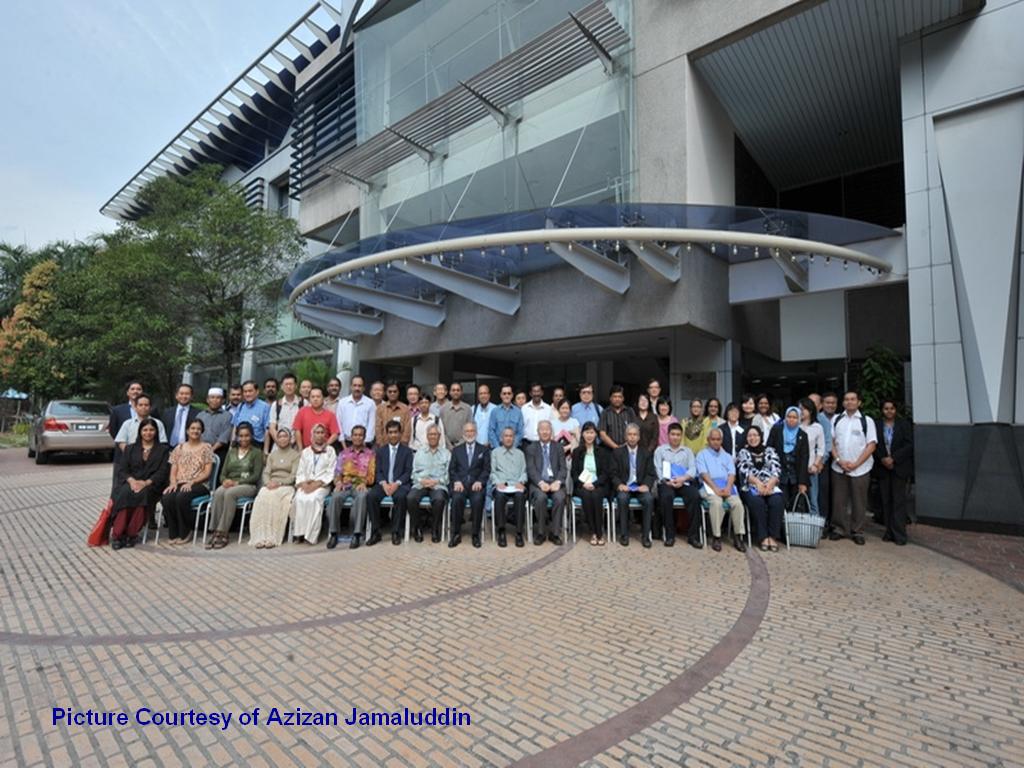
Part of the participants of the colloquium

The 3rd PhD OUM Colloquium was held at OUM Main Campus on 7th - 8th August, 2010. YBhg Dato' Ir. (Hj) Ahmad Zaidee Laidin, Academy of Science Malaysia has been kind enough to deliver his very enlightening keynote address entitled: "Innovation and Excellence in Research", to a group of over 60 PhD students of OUM who have come from as far as Sarawak and Singapore.


Tan Sri Dr. Anuwar Ali presenting a token of appreciation to Dato' Ahmad witnessed by Prof. Dr. Mohd Ghazali

One for the album


Earlier, Emeritus Professor Tan Sri Anuwar Ali, President/Vice Chancellor of OUM delivered has welcoming address. Also present were Prof. Dr. Mansor Fadzil, Senior VP of OUM, Prof. Dr. Rosli, VP of OUM, Prof. Ramli Bahroom, Financial Controller of OUM and Prof. Mohd Ghazali, Dean of the Centre for Graduate Studies.

Dr. Nagarajah facilitating the session on research instrument development.

Part of the participants during the workshop assisted by Prof. Dr. Zuraidah (black jacket)

Part of the participants during tea break

During the 2-day colloquium, participants were exposed to matters related to the development of research instruments and the various statistics to test the models by Associate Prof. Dr. Nagarajah Lee and Associate Prof. Dr. Chung. A hands-on workshop were also conducted on how to use AMOS.

Seng Poh presenting her mock viva


Siow Ming presenting her mock viva

At the end of the colloquium, 2 PhD students who are waiting for their viva, Siow Ming and Seng Poh, were invited to present their Mock Viva.

Patrick Wong (left) and Richard Ng (right) were the other 2 PhD candidates waiting for their viva

Generally the participants were very satisfied with the colloquium. A big syabas to Prof. Ghazali, Dean of the Centre for Graduate Studies of OUM and his team for organizing this colloquium.

Thursday, August 5, 2010

2011 2nd World Congress on Computer Science and Information Engineering (CSIE 2011)

2011 2nd World Congress on Computer Science and Information Engineering (CSIE 2011)
17-19 June 2011, Changchun, China

Call for Papers

CSIE 2011 intends to be a global forum for researchers and engineers to present and discuss recent advances and new techniques in computer science and information engineering. Topics of interests include, but are not limited to, data mining & data engineering, intelligent systems, software engineering, computer applications, communications & networking, computer hardware, VLSI, & embedded systems, multimedia & signal processing, computer control, robotics, and automation.

All papers in the CSIE 2011 conference proceedings will be indexed in Ei Compendex and ISTP, as well as included in the IEEE Xplore (The previous conference CSIE 2009 has already been indexed in Ei Compendex and included in the IEEE Xplore). IEEE Catalog Number: CFP1160F-PRT. ISBN: 978-1-4244-8361-7.

Changchun is the capital city of Jilin province, situated in the central section of China's northeast region. There are many natural attractions to entertain residents and visitors around Changchun. The grand Changbai Mountain renowned for its spectacular landscape, charming scenery, glamorous legends, as well as rich resources and products, has been praised as the first mountain in the northeast, outstanding as one of the China’s top-ten famous mountains. Other attractions in or around Changchun include Songhua lake (Songhuahu), Jingyue Lake (Jingyuetan), Changchun Movie Wonderland, Changchun Puppet Palace (Weihuanggong), Changchun World Sculpture Park, and Changchun World Landscape Park, etc.

Important Dates:

Paper Submission Deadline: 20 September 2010
Review Notification: 15 November 2010
Final Paper and Author Registration Deadline: 6 January 2011

Contact Information

If you have any inquiries, please email us at CSIE2011@cust.edu.cn

For details: http://world-research-institute.org/conferences/CSIE/2011

PhD for working mum, dad after the sacrifice and guilt - The Star

USUALLY, it’s the parents who beam proudly during their children’s convocation but for siblings I. Pavithran and I. Mritickah, it was the opposite.

The children were grinning widely when their parents S. Ilangko and J. Paramaswari, both 45, were conferred the Doctor of Philosophy degrees at the first session of the convocation ceremony yesterday.

“We are very happy and proud. At home my sister and I try not to disturb them when they are studying, otherwise, they will take a very long time to finish,” eight-year-old Pavithran said.

His sister Mritickah, 10, said they would sometimes ask about their parents’ studies.

“I want to do my PhD too but I wish to study abroad,” said Mritickah who speaks Man-darin.

Ilangko, who is a senior assistant (administration) at St George’s Girls School and Paramaswari, who teaches at Convent Datuk Keramat, obtained both their bachelor and master’s degrees from USM.

“I am from Selangor and my wife is from Kuala Lumpur. Since our undergraduate days in USM, we already decided to complete our postgraduate studies together in the same university.

“We received our master’s degrees in 2000,” Ilangko said.

Ilangko, who received a scholarship from the Education Ministry, did his research on co-curricular activities while his wife focused on the local community’s participation in helping those with HIV and AIDS.

“We dedicate this achievement to our children because our studies have taken so much of our time away from them. There are moments when I feel a little guilty and have even thought of giving up,” he said.

Describing the doctorate degree as a “very lonely journey”, Paramaswari said she was fortunate to be able to share the experience with her husband.

She said despite the different topics, the couple were able to discuss their work.

“Being a working mother, it was such a challenge. I had to take six months unpaid leave for my field work.

Asked about their future plans, Paramaswari said the family was planning a holiday.

p-value calculator

You can now obtain the p-value required for hypothesis testing be it one tailed or two tailed by using the the p-value calculator courtesy of Daniel S. Soper.

All you need to do is to enter the value of t obtained and the degrees of freedom and bingo ... you will be shown the p-value together with the graphical representation.


The link to this calculator is as follows: http://www.danielsoper.com/statcalc/calc08.aspx

Sunday, August 1, 2010

Online polls on youth - The Star

By PRIYA KULASAGARAN (educate@thestar.com.my)

LOCAL researchers looking to delve into the minds of Malaysian youth now have a new resource to base their research on. In a bid to reach out to young people, Universiti Tunku Abdul Rahman (Utar) has started a year-long series of online opinon polls which focus on youth issues.

Officially launched in July, the initiative is the brainchild of Utar vice-president (R&D and commercialisation) Prof Lee Sze Wei.

“The point is to gather raw data for researchers who are looking into certain aspects of society, and being a non-commercial enterprise, we will share our findings with participants and interested parties.

“Ultimately, we want to reach out to other members of society as well; right now we want to build up a base of followers first,” he said.

He added that for the purposes of the polls, the definition of youth would generally be those below the age of 30. While conceding that online polls have their weaknesses, Prof Lee said that the benefits outweigh the shortcomings.

From left: Prof Lee, Dr Wu, Datuk Ng Poh Tip, Utar Centre for Media and Creative Communication chairperson and Chin Yee Mun (standing) its Faculty of Creative Industries lecturer, during an interview on the varsity’s online polls initiative.

“It’s a very cost-effective process, and this platform makes sense if we want to engage young people since using the Internet is second nature to them.

“Also I don’t think there will be much room for fraudulent responses, as the registration process requires a fair amount of time and personal details which can be verified,” he said.

To entice young people to spare a few minutes to participate in the polls, Utar has teamed up with KFC and Pizza Hut to offer rewards to respondents.

Not only will the first 1,000 respondents of each poll receive discount vouchers at the fast-food outlets, but those who chalk up the most number of referrals each quarter, stand to receive a grand prize of meal vouchers worth up to RM2,000.

“This is to give the respondents a value-added experience so that they will continuously participate in the initiative,” said Centre for Social Change and Trends chairperson Dr Wu Ming Chu.

“We’re in the process of sourcing out more sponsors to offer even more prizes for future polls.”

The first poll in the series started on July 1, and deals with young adults’ lifestyles and how they spend their study, work and leisure time.

As of July 28, a total of 2151 respondents had taken part in the survey, mostly university students and young working adults.

At the time of print, a full analysis of the data had yet to be completed; but the team has drawn some conclusions on the information gathered so far.

For instance, it appears that most young people rate surfing the Internet (49% of students and 34% of working adults) and watching TV (12% of students and 18% of working adults) as the top ways to spend their leisure time. This is something that Prof Lee is concerned about.

“Although the working adult group seem to socialise more compared to students, it is a bit worrying to see that activities that involve real human interaction rank quite low.

“I wonder if this has any correlation to fresh graduates encountering problems in the workplace because they lack proper communication skills,” he said.

The issues to be tackled by upcoming polls include political awareness, health and hygiene, and familial relationships, but Prof Lee shared that the team is open to more suggestions.

“Anyone can approach us with their ideas, be it researchers, non-governmental organisations or government agencies - we’ve even teamed up with The Star to run a special poll on youth views of sex,” he said.

“In fact, the August poll is driven by specific research needs, where we will touch on gambling.

“Our current hypothesis is that young people will have a generally negative view on sports betting and gambling, but who knows, maybe their responses will surprise us.”

Titled ‘Youth and Gambling’, this month’s poll goes live today and will run until August 31.

To be part of the Utar opinion polls, log on to http://
poll.utar.edu.my.