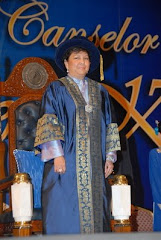
To be a PhD student at the age of 74 maybe unthinkable for most people but to me it’s very satisfying. Age and calamity has never been a barrier to my education. During the World War II, there was a brief interruption to my studies but I went on to pursue my degree in BBA studies at RMIT, Melbourne Australia. Then later around the age of 50 I did my Masters, again at overseas. This time at the prestigious Henley Management College, UK. Now after my quest around the world in search of quality education, I come back a full circle to Malaysia – Open University Malaysia for my PhD.
The field of my PhD study? The very intriguing area of Strategy Turnaround. This topic is indeed very applicable especially in the Malaysian context where we are facing times of crisis like the rise in petrol prices. How do we cope with these crisis and turn them around for our benefit? Indeed I’m glad that OUM offers such a unique subject for my research. My only problem now is the very short deadlines. My paper is purely research and keeping up deadlines is very difficult. However, I appreciate the staff at the Centre for Graduate Studies who are generally sociable and friendly.
Currently, I am teaching part-time at various colleges in Klang Valley. Prior to teaching, I have worked for about 40 years in a number of multinational companies like Coopers and Price-Waterhouse. I’m very proud to say that I have both working experience and academic qualifications – theory and practice – something which is quite uncommon these days. I’m also very happy to share my vast experience with my young students. Since my background is in accounting, I teach management and accounting related subjects in overseas university programmes.
What are my objectives to pursue my PhD? Basically I have three objectives:
* To prove to myself that at my age it is never too late to learn.
* To prove to the younger generation that learning is never too late. In fact, I tell all my students that I’m currently pursuing my PhD. The journey of learning will never end.
* As a teacher, my role is to bridge theory with practice. There is a saying, “theory without practice is empty, and practice without theory is blind......”
In order to be a good student, one needs to have a good time management. In my case, to find time to do assignments. Another important requirement is to enjoy reading. Often, I will use the resources at OUM’s digital library and e-learning platform. I also very much enjoy the lively seminars here.
Balancing time is crucial as a working learner. I have to travel quite far from my home at Petaling Jaya to the college and prepare all the materials as a lecturer of a higher institution. In terms of family, I have only one son who is now working in the US as an engineer. Yet in spite of it all I do not regret doing my PhD because it provides me with a feeling of self-satisfaction.
Source: OUM Learner Connexxion (August 2008 Issue)
Wednesday, August 27, 2008

Friday, August 8, 2008
You say ‘tomahto’ and I say ‘tomayto’ - Star
You say ‘tomahto’ and I say ‘tomayto’
Ramblings
Aug 8, 2008 By Dr LIM CHIN LAM
ENGLISH is used in many countries — originally Britain, then the countries that started off as colonies, dominions, and protectorates of Britain. It is now used, to varying extents and to various degrees of proficiency, in the rest of the world.
The native English-speaking countries (Australia, Canada, New Zealand and the United States) and those in which English is used to a large extent (India, Malaysia, Fiji, South Africa, Zimbabwe, Uganda, etc.) each have their brand of English. Even then, these different Englishes are generally intelligible to the users of English at large.
But are they?
Let us look at British English (BrE) and American English (AmE, specifically North American English), the two most widely used kinds of English. The English spoken in other countries generally follows BrE or AmE — but with its own peculiarities. In Malaysia, the English we use is of the British variety.
BrE and AmE differ in many areas which I can but try to classify and summarise, with limited examples, within the constraints of this column.
Same words, different pronunciations
The word herb is pronounced HERB in BrE but ERB in AmE.
Other examples: chance (CHAHNS/CHENS – the same difference in vowel sound also in class, command, dance, grass, past); fertile (FERTYL/FERTL); consortium (KONSORTIEM/KONSORSHIUM); route (ROOT/ROWT), schedule (SHEDIUL/SKEDIUL); and so on.
Same words, difference in spelling
Nowadays, the ligatures “æ” and “?” are rarely encountered. BrE tends to separate out the conjoined vowels in print while AmE reduces them to the single letter ‘e’.
Examples: anaemia/anemia, diarrhoea/diarrhea, encyclopaedia/encyclopedia, foetus/fetus, oedema/edema.
Furthermore, AmE tends to differ from BrE in the following ways.
· dropping silent vowels [axe/ax, acknowledgement/acknowledgment, furore/furor/]
· dropping a vowel from a digraph [caulk/calk; gauge/gage, mould/mold]
· reducing doubled consonants to a single consonant [waggon/wagon]
· trimming off unsounded letter clusters [dialogue/dialog, programme/program — except that both BrE and AmE use program to refer to computer software]
· adding, for words ending in an unstressed syllable with a terminal ‘l’, a suffix beginning with a vowel without doubling the final ‘l’ [travelled/traveled, counselling/counseling, medallist/medalist, councillor/councilor, marvellous/marvelous. Note, however, that in words such as compel and propel, where the last syllable is stressed, the BrE-styled compelled and propellant also apply in AmE.]
· choosing –or over –our [colour/color, odour/odor].
Yet, against its common practice of trimming off vowels and consonants, AmE actually adds on a consonant by doubling it in such words as enrol/enroll, enrolment/enrollment, instil/instill, and skilful/skillful.
Other differences are in respect of deletion of vowels [caulk/calk, gauntlet/gantlet]; word-ending –ce/se [defence/defense; pretence/pretense]; and verb suffix –ise/-ize [BrE accepts both, e.g. realise and realize, but AmE normally admits only the –ize suffix; furthermore, AmE extends the –z- ending to words not formed with the original Greek verb suffix –izein, e.g. analyze (BrE analyse), paralyze (BrE paralyse) and advertize (BrE advertise); and differentiation between noun and verb [BrE noun practice, verb practise but AmE noun and verb practice; similarly BrE licence (noun) and license (verb) as against AmE license (noun, verb) — but advice (noun) and advise (verb) and device (noun) and devise (verb) are differentiated in AmE, as in BrE)].
And still there are other differences: -que/-ck [cheque/check, racquet/racket]; ph/f [sulphate/sulfate, draught/draft], -re/-er [centre/center, theatre/theater, manoeuvre/maneuver, calibre/caliber, fibre/fiber]; and a miscellaneous group of one-offs [aluminium/aluminum, candidature/candidacy, jewellery/jewelry, kerb/curb, ketchup/catsup, sceptical/skeptical, storey/story].
Same words, different meanings
Some BrE words seem to have acquired a different meaning after crossing the Atlantic Ocean. For example, dumb means “mute” in Britain but “stupid” in the U.S. The word mad means “insane” in Britain but “very angry, furious” in the U.S.
Homely, meaning “simple and ordinary” in BrE, becomes a disparaging attribute in AmE where it means “unattractive”. The adjective nuts, used predicatively (Are you nuts?), apparently does not exist in Britain but it means “crazy” in AmE.
Different words, same meaning
Americanisms include the use of words different from those used in British English.
For example, in AmE, funny = odd/peculiar, mad = angry, and nuts = mad/crazy. The Americans can be funny (i.e. odd). They can make you mad (i.e. angry) or drive you nuts (i.e. crazy).
Because different words are used for the same things on either side of the Atlantic — and are likely to cause confusion — I take the trouble to put up a longer-than-usual list of examples, as follows:
aerial (BrE) = antenna (AmE),
brinjal = eggplant,
barrister/solicitor = attorney/lawyer,
bill (e.g. for restaurant meal) = check,
boot (of car) = trunk,
conscription = draft,
crossroads = intersection,
counterfeit/false = fake/phoney,
flyover = overpass,
full-stop = period,
fuss = hassle,
groundnut = peanut,
joking = kidding,
leave (of absence) = furlough,
letter-box = mailbox,
maize = corn,
pavement = sidewalk,
petrol = gasoline,
post-mortem = autopsy,
prison = penitentiary,
ragging = hazing,
refuse/rubbish/waste = garbage/trash,
tap = faucet,
taxi (from “taxicab”) = cab (from “taxicab”),
toilet = lavatory/restroom,
torchlight = flashlight,
truant (play truant) = hooky (play hooky),
wrecked (as of a car in an accident) = totaled.
Is that all?
I have thus far covered — adequately, I hope — BrE and AmE differences in words as they are pronounced, as spelt, and as differing in meaning. But the divide between BrE and AmE is not only in words. I shall cover other aspects in a future article.
Ramblings
Aug 8, 2008 By Dr LIM CHIN LAM
ENGLISH is used in many countries — originally Britain, then the countries that started off as colonies, dominions, and protectorates of Britain. It is now used, to varying extents and to various degrees of proficiency, in the rest of the world.
The native English-speaking countries (Australia, Canada, New Zealand and the United States) and those in which English is used to a large extent (India, Malaysia, Fiji, South Africa, Zimbabwe, Uganda, etc.) each have their brand of English. Even then, these different Englishes are generally intelligible to the users of English at large.
But are they?
Let us look at British English (BrE) and American English (AmE, specifically North American English), the two most widely used kinds of English. The English spoken in other countries generally follows BrE or AmE — but with its own peculiarities. In Malaysia, the English we use is of the British variety.
BrE and AmE differ in many areas which I can but try to classify and summarise, with limited examples, within the constraints of this column.
Same words, different pronunciations
The word herb is pronounced HERB in BrE but ERB in AmE.
Other examples: chance (CHAHNS/CHENS – the same difference in vowel sound also in class, command, dance, grass, past); fertile (FERTYL/FERTL); consortium (KONSORTIEM/KONSORSHIUM); route (ROOT/ROWT), schedule (SHEDIUL/SKEDIUL); and so on.
Same words, difference in spelling
Nowadays, the ligatures “æ” and “?” are rarely encountered. BrE tends to separate out the conjoined vowels in print while AmE reduces them to the single letter ‘e’.
Examples: anaemia/anemia, diarrhoea/diarrhea, encyclopaedia/encyclopedia, foetus/fetus, oedema/edema.
Furthermore, AmE tends to differ from BrE in the following ways.
· dropping silent vowels [axe/ax, acknowledgement/acknowledgment, furore/furor/]
· dropping a vowel from a digraph [caulk/calk; gauge/gage, mould/mold]
· reducing doubled consonants to a single consonant [waggon/wagon]
· trimming off unsounded letter clusters [dialogue/dialog, programme/program — except that both BrE and AmE use program to refer to computer software]
· adding, for words ending in an unstressed syllable with a terminal ‘l’, a suffix beginning with a vowel without doubling the final ‘l’ [travelled/traveled, counselling/counseling, medallist/medalist, councillor/councilor, marvellous/marvelous. Note, however, that in words such as compel and propel, where the last syllable is stressed, the BrE-styled compelled and propellant also apply in AmE.]
· choosing –or over –our [colour/color, odour/odor].
Yet, against its common practice of trimming off vowels and consonants, AmE actually adds on a consonant by doubling it in such words as enrol/enroll, enrolment/enrollment, instil/instill, and skilful/skillful.
Other differences are in respect of deletion of vowels [caulk/calk, gauntlet/gantlet]; word-ending –ce/se [defence/defense; pretence/pretense]; and verb suffix –ise/-ize [BrE accepts both, e.g. realise and realize, but AmE normally admits only the –ize suffix; furthermore, AmE extends the –z- ending to words not formed with the original Greek verb suffix –izein, e.g. analyze (BrE analyse), paralyze (BrE paralyse) and advertize (BrE advertise); and differentiation between noun and verb [BrE noun practice, verb practise but AmE noun and verb practice; similarly BrE licence (noun) and license (verb) as against AmE license (noun, verb) — but advice (noun) and advise (verb) and device (noun) and devise (verb) are differentiated in AmE, as in BrE)].
And still there are other differences: -que/-ck [cheque/check, racquet/racket]; ph/f [sulphate/sulfate, draught/draft], -re/-er [centre/center, theatre/theater, manoeuvre/maneuver, calibre/caliber, fibre/fiber]; and a miscellaneous group of one-offs [aluminium/aluminum, candidature/candidacy, jewellery/jewelry, kerb/curb, ketchup/catsup, sceptical/skeptical, storey/story].
Same words, different meanings
Some BrE words seem to have acquired a different meaning after crossing the Atlantic Ocean. For example, dumb means “mute” in Britain but “stupid” in the U.S. The word mad means “insane” in Britain but “very angry, furious” in the U.S.
Homely, meaning “simple and ordinary” in BrE, becomes a disparaging attribute in AmE where it means “unattractive”. The adjective nuts, used predicatively (Are you nuts?), apparently does not exist in Britain but it means “crazy” in AmE.
Different words, same meaning
Americanisms include the use of words different from those used in British English.
For example, in AmE, funny = odd/peculiar, mad = angry, and nuts = mad/crazy. The Americans can be funny (i.e. odd). They can make you mad (i.e. angry) or drive you nuts (i.e. crazy).
Because different words are used for the same things on either side of the Atlantic — and are likely to cause confusion — I take the trouble to put up a longer-than-usual list of examples, as follows:
aerial (BrE) = antenna (AmE),
brinjal = eggplant,
barrister/solicitor = attorney/lawyer,
bill (e.g. for restaurant meal) = check,
boot (of car) = trunk,
conscription = draft,
crossroads = intersection,
counterfeit/false = fake/phoney,
flyover = overpass,
full-stop = period,
fuss = hassle,
groundnut = peanut,
joking = kidding,
leave (of absence) = furlough,
letter-box = mailbox,
maize = corn,
pavement = sidewalk,
petrol = gasoline,
post-mortem = autopsy,
prison = penitentiary,
ragging = hazing,
refuse/rubbish/waste = garbage/trash,
tap = faucet,
taxi (from “taxicab”) = cab (from “taxicab”),
toilet = lavatory/restroom,
torchlight = flashlight,
truant (play truant) = hooky (play hooky),
wrecked (as of a car in an accident) = totaled.
Is that all?
I have thus far covered — adequately, I hope — BrE and AmE differences in words as they are pronounced, as spelt, and as differing in meaning. But the divide between BrE and AmE is not only in words. I shall cover other aspects in a future article.
Thursday, August 7, 2008
Varsities to get billions for fundamental research - NST
PUTRAJAYA: Aug 7, 2008 By Hamidah Atan
The government has set aside billions in Ninth Malaysia Plan allocations for fundamental research by local universities.
The Higher Education Ministry has given out RM239 million to be spent on specific and relevant researches, while the Science, Technology and Innovation Ministry has allocated RM1.2 billion and RM1.5 billion for the science and technology funds respectively.
Higher Education Minister Datuk Seri Mohamed Khaled Nordin yesterday said "whatever it is, the research must be relevant to industrial needs, knowledge and current needs".
"We want all universities to upgrade or enhance research and development in all areas, such as natural gas or energy.
"One of the criteria they must consider is the relevance of the project or research to the industries. Fundamental and energy crisis researches are already being carried out in most of the universities in collaborations with private companies such as Proton Holdings Bhd and Petronas Bhd.
"Research on solar energy is being actively undertaken by Universiti Teknologi Malaysia. All these are relevant to the current energy crisis we are facing," he told a press conference to explain the progress report of the national higher education strategic plan for the period between August 2007 and June 2008.
The strategic plan was launched last year by Prime Minister Datuk Seri Abdullah Ahmad Badawi.
Under the plan's third thrust, enhancement of research and innovation, four universities -- Universiti Malaya, Universiti Sains Malaysia, Universiti Kebangsaan Malaysia and Universiti Putra Malaysia -- have been recognised as research universities.
On the enrolment for both public and local universities and colleges, Khaled said the number had increased by 13.3 per cent, from 748,130 in 2006 to 847,485 last year.
He also revealed an increase in the number of National Higher Education Corporation (PTPTN) loan borrowers from 949,527 in 2006 to 1,110,091 last year.
Borrowers paid back a total of RM294,754,200 last year, against RM192,499,700 in 2006. Since early this year, a total of RM87,886,400 had been collected.
Khaled also said he would announce the new service fee on PTPTN loans next week. The charge at present is three per cent of the loan amount.
The government has set aside billions in Ninth Malaysia Plan allocations for fundamental research by local universities.
The Higher Education Ministry has given out RM239 million to be spent on specific and relevant researches, while the Science, Technology and Innovation Ministry has allocated RM1.2 billion and RM1.5 billion for the science and technology funds respectively.
Higher Education Minister Datuk Seri Mohamed Khaled Nordin yesterday said "whatever it is, the research must be relevant to industrial needs, knowledge and current needs".
"We want all universities to upgrade or enhance research and development in all areas, such as natural gas or energy.
"One of the criteria they must consider is the relevance of the project or research to the industries. Fundamental and energy crisis researches are already being carried out in most of the universities in collaborations with private companies such as Proton Holdings Bhd and Petronas Bhd.
"Research on solar energy is being actively undertaken by Universiti Teknologi Malaysia. All these are relevant to the current energy crisis we are facing," he told a press conference to explain the progress report of the national higher education strategic plan for the period between August 2007 and June 2008.
The strategic plan was launched last year by Prime Minister Datuk Seri Abdullah Ahmad Badawi.
Under the plan's third thrust, enhancement of research and innovation, four universities -- Universiti Malaya, Universiti Sains Malaysia, Universiti Kebangsaan Malaysia and Universiti Putra Malaysia -- have been recognised as research universities.
On the enrolment for both public and local universities and colleges, Khaled said the number had increased by 13.3 per cent, from 748,130 in 2006 to 847,485 last year.
He also revealed an increase in the number of National Higher Education Corporation (PTPTN) loan borrowers from 949,527 in 2006 to 1,110,091 last year.
Borrowers paid back a total of RM294,754,200 last year, against RM192,499,700 in 2006. Since early this year, a total of RM87,886,400 had been collected.
Khaled also said he would announce the new service fee on PTPTN loans next week. The charge at present is three per cent of the loan amount.
Monday, July 28, 2008
Koh: Post-doctoral fellows should not be regarded as students - The Star
GEORGE TOWN (July 28, 2008): by Bernard Cheah
Gerakan has objected to the definition of "student" being expanded to include post-doctoral fellows and people pursuing distance-learning and off-campus programmes in the proposed amendments to the University and University College Act (UUCA) 1971.
 Tan Sri Dr Koh Tsu Koon "Post-doctoral fellows are no longer students even in the loose sense of the word," Gerakan acting president Tan Sri Dr Koh Tsu Koon said in a statement today.
"They are almost like faculty members as they often do research and work as teaching assistants as well.
"Students enrolled in distance-learning and off-campus programmes should also not be subjected to the same definition of 'student' because they are only studying part-time, while having another job and other responsibilities.
"They are also not on the campus most of the time, except for tutorials over weekends."
Koh said these people should be allowed to engage in other activities, including taking part in political parties, as they are usually given a flexible time-frame to complete their studies.
"In this way, we hope that our local universities will then be able to attract the best and the brightest, including Malaysian scholars currently overseas, to teach our students and to do research locally," he said.
"This will contribute towards our objective of having world-class universities."
Koh welcomed the proposed amendments as they would give greater autonomy to university administrators and professors, and greater freedom to students.
He said Gerakan had been calling for amendments to the UUCA for a long time, especially the "draconian restrictions" on students in Section 15 as well as the "top-down" procedure for appointment of top posts, such as the vice chancellor (VC), deputy vice chancellor (DVC) and deans.
"We welcome the proposed amendment whereby the VCs and DVCs will no longer be political appointments but appointed on the advice of a selection committee and deans, in consultation with the faculty members," he said.
Koh said the change is important to allow more objective talent hunt, where chosen leaders will be well accepted and respected by other academics and students.
"It will create a more conducive environment for the pursuit of knowledge, innovations and research. This is very much in line with our nation's commitment to achieve a knowledge society with a competitive economy in the context of globalisation," he said.
Gerakan has objected to the definition of "student" being expanded to include post-doctoral fellows and people pursuing distance-learning and off-campus programmes in the proposed amendments to the University and University College Act (UUCA) 1971.
 Tan Sri Dr Koh Tsu Koon "Post-doctoral fellows are no longer students even in the loose sense of the word," Gerakan acting president Tan Sri Dr Koh Tsu Koon said in a statement today.
"They are almost like faculty members as they often do research and work as teaching assistants as well.
"Students enrolled in distance-learning and off-campus programmes should also not be subjected to the same definition of 'student' because they are only studying part-time, while having another job and other responsibilities.
"They are also not on the campus most of the time, except for tutorials over weekends."
Koh said these people should be allowed to engage in other activities, including taking part in political parties, as they are usually given a flexible time-frame to complete their studies.
"In this way, we hope that our local universities will then be able to attract the best and the brightest, including Malaysian scholars currently overseas, to teach our students and to do research locally," he said.
"This will contribute towards our objective of having world-class universities."
Koh welcomed the proposed amendments as they would give greater autonomy to university administrators and professors, and greater freedom to students.
He said Gerakan had been calling for amendments to the UUCA for a long time, especially the "draconian restrictions" on students in Section 15 as well as the "top-down" procedure for appointment of top posts, such as the vice chancellor (VC), deputy vice chancellor (DVC) and deans.
"We welcome the proposed amendment whereby the VCs and DVCs will no longer be political appointments but appointed on the advice of a selection committee and deans, in consultation with the faculty members," he said.
Koh said the change is important to allow more objective talent hunt, where chosen leaders will be well accepted and respected by other academics and students.
"It will create a more conducive environment for the pursuit of knowledge, innovations and research. This is very much in line with our nation's commitment to achieve a knowledge society with a competitive economy in the context of globalisation," he said.
Thursday, July 24, 2008
SPSS for Dummies by Arthur Griffith John Wiley & Sons © 2007
Here is another book on SPSS which is available in the Books24x7 collection.
 SPSS for Dummies
by Arthur Griffith
John Wiley & Sons © 2007 (360 pages)
ISBN:9780470113448
Covering all of the key analysis topics step-by-step, this friendly, plain-English guide gets you up and running with the latest version of the software so that you can start performing calculations right away.
I have picked an excerpt from Chapter 14 on some examples of analysis which I believe might be useful for new researchers:
Independent-samples T test
The independent-samples T test compares the means of two sets of values from one variable.
 Click picture to enlarge
The table displays the two means and the standard deviation and standard error for the two means. The Independent Samples Test table provides further information about the mean in two rows of numbers — one for equal variances and one for unequal variances:
* If the significance of the Levene test, the number in the second column, is high (greater than 0.05 or so), the values in the first row are applicable.
* If the significance of the Levene test is low, the numbers in the second row are more applicable.
* If the significance of the T test, the 2-tailed significance, is low, this indicates a significant difference in the two means.
* If none of the numbers of the 95% confidence interval are 0, it indicates the difference is significant.
One-way ANOVA
 Click picture to enlarge
ANOVA is an analysis of variance. A one-way ANOVA is the analysis of the variance of the values (of a dependent variable) by comparing them against another set of values (the independent variable). It is a test of the hypothesis that the mean of the tested variable is equal to that of the factor.
Correlation
The group of tests in this section determines the similarity or difference in the way two variables change in value from one case (row) to another through the data.
 Click picture to enlarge
Correlation figures vary from −1 to +1, and the larger the value, the stronger the correlation. In Figure above, you can see that the variables have a correlation of 1 with themselves and .880 with one another, which is a significant correlation.
Regression
Regression analysis is about predicting the future (the unknown) based on data collected from the past (the known). A regression analysis determines the mathematical equation to be used to figure out what will happen, within a certain range of probability. It analyzes one variable, the dependent variable, taking into consideration the effect on it by one or more factors, the independent variables. The analysis determines that some independent variables have more effect than others, so their weights must be taken into account when they are the basis of a prediction. Regression analysis, therefore, is the process of looking for predictors and determining how well they predict.
 Click picture to enlarge
When only one independent variable is taken into account, it's called a simple regression. If you use more than one independent variable, it's called multiple regression.
 SPSS for Dummies
by Arthur Griffith
John Wiley & Sons © 2007 (360 pages)
ISBN:9780470113448
Covering all of the key analysis topics step-by-step, this friendly, plain-English guide gets you up and running with the latest version of the software so that you can start performing calculations right away.
I have picked an excerpt from Chapter 14 on some examples of analysis which I believe might be useful for new researchers:
Independent-samples T test
The independent-samples T test compares the means of two sets of values from one variable.
 Click picture to enlarge
The table displays the two means and the standard deviation and standard error for the two means. The Independent Samples Test table provides further information about the mean in two rows of numbers — one for equal variances and one for unequal variances:
* If the significance of the Levene test, the number in the second column, is high (greater than 0.05 or so), the values in the first row are applicable.
* If the significance of the Levene test is low, the numbers in the second row are more applicable.
* If the significance of the T test, the 2-tailed significance, is low, this indicates a significant difference in the two means.
* If none of the numbers of the 95% confidence interval are 0, it indicates the difference is significant.
One-way ANOVA
 Click picture to enlarge
ANOVA is an analysis of variance. A one-way ANOVA is the analysis of the variance of the values (of a dependent variable) by comparing them against another set of values (the independent variable). It is a test of the hypothesis that the mean of the tested variable is equal to that of the factor.
Correlation
The group of tests in this section determines the similarity or difference in the way two variables change in value from one case (row) to another through the data.
 Click picture to enlarge
Correlation figures vary from −1 to +1, and the larger the value, the stronger the correlation. In Figure above, you can see that the variables have a correlation of 1 with themselves and .880 with one another, which is a significant correlation.
Regression
Regression analysis is about predicting the future (the unknown) based on data collected from the past (the known). A regression analysis determines the mathematical equation to be used to figure out what will happen, within a certain range of probability. It analyzes one variable, the dependent variable, taking into consideration the effect on it by one or more factors, the independent variables. The analysis determines that some independent variables have more effect than others, so their weights must be taken into account when they are the basis of a prediction. Regression analysis, therefore, is the process of looking for predictors and determining how well they predict.
 Click picture to enlarge
When only one independent variable is taken into account, it's called a simple regression. If you use more than one independent variable, it's called multiple regression.
Ph. D. Qualifying Exams: Making it to the Other Side
By Melissa Sanchez, Ph.D Student
English & Comparative Literature
For many students who have not yet taken their Ph.D. qualifying exams, the very idea evokes terrifying images of being trapped in a small room, surrounded by experts in your field who are grilling you on extraordinarily difficult questions and waiting for you to trip yourself up. The idea of writing a dissertation may be stressful and intimidating, but the qualifying exam somehow creates a more immediate and clear-cut sense of terror.
If you feel this way about taking your exams, you are not alone. The qualifying exam is undeniably rigorous, and you will need to do a lot of hard work in order to pass this milestone successfully. It may help to remember, however, that the majority of students do pass and that there are steps you can take to increase your chances of doing the same.
• Put the exam in perspective. While the Ph.D. exam certainly requires that you know a great deal about your field, it is also intended to test your ability to communicate this knowledge. “You’ve got to convince people that you really know what you’re talking about,” says former Berkeley Associate Graduate Dean Daniel Melia. “It’s not just a question of what you know, it’s a question of being able to impart what you know. . . this is something that you are going to have to do in your real life as a Ph.D.” In other words, while it is important to have a solid understanding of your field, try not to stress about all of the things that you don’t know. Instead, concentrate on presenting what you do know intelligently and confidently.
Talking to students who have already passed their exams is another way of putting the process into perspective. Not only can they give practical advice on organization and studying, but hearing about their experiences can be reassuring. The more that you talk to people who have already passed, the more confident you will feel about your ability to successfully navigate your own exams.
Finally, try to recognize that your committee wants you to pass. Most likely, your committee will be made up of professors that have contributed to your training over the years, so in a sense your success is a reflection on them. Also, because “you will represent their department when you leave the University,” your success is a reflection on the department as well. This doesn’t mean that you will pass if you are unprepared or incapable of answering the questions, but it does mean that your committee will do whatever they can to help you get through the exam successfully. As one student observed, “It was not a grill atmosphere . . . It was an attempt to give me every opportunity to show what I know.”
• Find out what is expected of you. You can do away with much of the stress of facing the qualifying exam if you demystify it as much as possible. Talk to your advisor and your committee members. Ask them what they expect you to be able to do when you take the exam. The more you know about what to expect from the actual exam, the better you can contain your studying so that you focus on things that will really matter. Find out as many specifics as possible: how long will the questions be? is it more important that you exhibit depth or breadth of knowledge? do you get any breaks? what materials are you allowed to bring to the exam? how can you best organize your time as you prepare? what are the most important things you should be reading?
Another excellent source of information about the exams is students who have already passed, particularly those with whom you have committee members in common. Try to find out which professors like to ask tricky questions, how previous examinees structured their answers, what they wish they had known beforehand. Again, the more information you have, the more confident you’ll be about your own preparation.
Even something as simple as familiarizing yourself with the physical surroundings in which you will take your exam can be helpful. Prior to the actual date of the exam, visit the room in which it will be held. Plan how you will arrange your materials and where you will sit. Visualize yourself entering that room prepared to communicate all of the knowledge you have accrued from the studying you’ve been doing.
• Learn the material. It may seem self-evident to say that you need to know the material in order to pass the exam, but students have been known to enter the examination room still unsure about key concepts in their field. Moreover, “the best defense against nervousness is to really know the material.” If you are unsure about an area that your committee has advised you to study, do not just ignore it and hope it doesn’t come up during the exam. Instead, spend some time working through the problem until you feel that you can talk about it with some degree of confidence. “The things I had problems with on the exam were the things I’d had problems with before conceptually and never followed up on,” said one student. You can’t be expected to know everything about your field, but do make sure that you are well-versed on its key issues, concepts, and methodologies.
• Practice Answering the Questions. Remember, knowing your facts is only half the battle; you also have to be able to demonstrate that you can communicate knowledge clearly and effectively. Depending on your department, you may be asked to take a written exam, an oral exam, or both. Whatever the format of your qualifying exam, you’ll feel a lot less nervous if you’ve practiced the skills that you’ll need to pass.
One way of practicing for the exam is to develop a list of questions and go over it with your advisor. S/he will be able to tell you if you have missed potentially important questions. Once you have a fairly solid ideal of what you will be asked, practice answering. If your exams will be written, write the answers as you would during the actual exam. This will give you an idea of how long it will take you to write each response and how to shape your answer so that it answers the question with the most relevant information.
If your exam will be oral, practice stating your answers aloud. Many students have never taken an oral examination and are unsure how to prepare for it. You might start by speaking into a tape recorder and then playing it back to evaluate the confidence and accuracy of your response. Or, you might get together with a group of fellow students, stage a mock exam, and then have them critique your performance. Remember to also practice how you will handle mistakes: “Rehearse saying that you don’t know. And plan what you will say in case you draw a blank. . . . Gain time by saying, ‘Let me take some time to consider that question.’ Your committee will understand and wait for you to recover.” Recognizing beforehand that your exam won’t go perfectly and preparing to handle those moments will help your performance much more than telling yourself that you have to be perfect.
• Approach the exam with a positive attitude. Look at the exam as an opportunity to demonstrate what you know. View your committee as a group of peers with whom you can discuss the work you’ve done. While it is true that your committee “is judging your ability to reason, synthesize, and communicate,” it is also true that “in many ways you are a peer in knowledge, particularly in your specialty areas.” Seize this opportunity to discuss your own work with a group of experts who are interested in and engaged with what you have to say.
Also, remember that you do have some degree of control over the exam. Take the amount of time you need to answer questions. Pause and think things through, rather than giving a rushed and disorganized response because you don’t want to hold things up. If you aren’t sure how to answer a question, repeat it in your own words or ask the committee member to repeat or rephrase it. If you wish to improve upon or add to a response you gave earlier, find a way to connect it with another question. Finally, if you honestly don’t know the answer, say so. Remember that “the examiners are trying to push the limits of what you know, so expect that they will find gaps. It’s not like a normal course exam where you are expected to know everything. If you don’t know, say so instead of blathering nonsense and irritating the examiners.” If you try to fake your way through an answer it will show, and admitting to not knowing everything will look much better than giving an evasive or contradictory answer.
Frightening as they seem, qualifying exams do not have to be (too much of a) torturous experience. As a graduate student, you are on your way to becoming a scholar and an expert in your field. Try to look at the qualifying exam as one more opportunity to expand your knowledge and expertise. Certainly, it’s a big milestone to pass, but do your best to get as much out of the experience as you can before you pass to the other side.
Notes
1“Studying for the Qualifying Exam,” The Graduate 2:3, University of California, Berkeley: The Graduate Division, 1986.
2 “The Qualifying Exam: Clearing the Hurdle,” The Graduate 2:3, University of California Berkeley: The Graduate Division, 1986.
3 Ibid.
4 Peters, Robert L., Getting What You Came For: The Smart Student’s Guide to Earning a Master’s or a Ph.D. (New York: Noonday, 1992): 158.
5 “Qualifying Exams: Clearing the Hurdle.”
6 Ibid.
7 Ibid.
8 Peters, 159.
Source: GradVoice Online - http://www.ags.uci.edu/~gvoice/99winter/qualify.html
English & Comparative Literature
For many students who have not yet taken their Ph.D. qualifying exams, the very idea evokes terrifying images of being trapped in a small room, surrounded by experts in your field who are grilling you on extraordinarily difficult questions and waiting for you to trip yourself up. The idea of writing a dissertation may be stressful and intimidating, but the qualifying exam somehow creates a more immediate and clear-cut sense of terror.
If you feel this way about taking your exams, you are not alone. The qualifying exam is undeniably rigorous, and you will need to do a lot of hard work in order to pass this milestone successfully. It may help to remember, however, that the majority of students do pass and that there are steps you can take to increase your chances of doing the same.
• Put the exam in perspective. While the Ph.D. exam certainly requires that you know a great deal about your field, it is also intended to test your ability to communicate this knowledge. “You’ve got to convince people that you really know what you’re talking about,” says former Berkeley Associate Graduate Dean Daniel Melia. “It’s not just a question of what you know, it’s a question of being able to impart what you know. . . this is something that you are going to have to do in your real life as a Ph.D.” In other words, while it is important to have a solid understanding of your field, try not to stress about all of the things that you don’t know. Instead, concentrate on presenting what you do know intelligently and confidently.
Talking to students who have already passed their exams is another way of putting the process into perspective. Not only can they give practical advice on organization and studying, but hearing about their experiences can be reassuring. The more that you talk to people who have already passed, the more confident you will feel about your ability to successfully navigate your own exams.
Finally, try to recognize that your committee wants you to pass. Most likely, your committee will be made up of professors that have contributed to your training over the years, so in a sense your success is a reflection on them. Also, because “you will represent their department when you leave the University,” your success is a reflection on the department as well. This doesn’t mean that you will pass if you are unprepared or incapable of answering the questions, but it does mean that your committee will do whatever they can to help you get through the exam successfully. As one student observed, “It was not a grill atmosphere . . . It was an attempt to give me every opportunity to show what I know.”
• Find out what is expected of you. You can do away with much of the stress of facing the qualifying exam if you demystify it as much as possible. Talk to your advisor and your committee members. Ask them what they expect you to be able to do when you take the exam. The more you know about what to expect from the actual exam, the better you can contain your studying so that you focus on things that will really matter. Find out as many specifics as possible: how long will the questions be? is it more important that you exhibit depth or breadth of knowledge? do you get any breaks? what materials are you allowed to bring to the exam? how can you best organize your time as you prepare? what are the most important things you should be reading?
Another excellent source of information about the exams is students who have already passed, particularly those with whom you have committee members in common. Try to find out which professors like to ask tricky questions, how previous examinees structured their answers, what they wish they had known beforehand. Again, the more information you have, the more confident you’ll be about your own preparation.
Even something as simple as familiarizing yourself with the physical surroundings in which you will take your exam can be helpful. Prior to the actual date of the exam, visit the room in which it will be held. Plan how you will arrange your materials and where you will sit. Visualize yourself entering that room prepared to communicate all of the knowledge you have accrued from the studying you’ve been doing.
• Learn the material. It may seem self-evident to say that you need to know the material in order to pass the exam, but students have been known to enter the examination room still unsure about key concepts in their field. Moreover, “the best defense against nervousness is to really know the material.” If you are unsure about an area that your committee has advised you to study, do not just ignore it and hope it doesn’t come up during the exam. Instead, spend some time working through the problem until you feel that you can talk about it with some degree of confidence. “The things I had problems with on the exam were the things I’d had problems with before conceptually and never followed up on,” said one student. You can’t be expected to know everything about your field, but do make sure that you are well-versed on its key issues, concepts, and methodologies.
• Practice Answering the Questions. Remember, knowing your facts is only half the battle; you also have to be able to demonstrate that you can communicate knowledge clearly and effectively. Depending on your department, you may be asked to take a written exam, an oral exam, or both. Whatever the format of your qualifying exam, you’ll feel a lot less nervous if you’ve practiced the skills that you’ll need to pass.
One way of practicing for the exam is to develop a list of questions and go over it with your advisor. S/he will be able to tell you if you have missed potentially important questions. Once you have a fairly solid ideal of what you will be asked, practice answering. If your exams will be written, write the answers as you would during the actual exam. This will give you an idea of how long it will take you to write each response and how to shape your answer so that it answers the question with the most relevant information.
If your exam will be oral, practice stating your answers aloud. Many students have never taken an oral examination and are unsure how to prepare for it. You might start by speaking into a tape recorder and then playing it back to evaluate the confidence and accuracy of your response. Or, you might get together with a group of fellow students, stage a mock exam, and then have them critique your performance. Remember to also practice how you will handle mistakes: “Rehearse saying that you don’t know. And plan what you will say in case you draw a blank. . . . Gain time by saying, ‘Let me take some time to consider that question.’ Your committee will understand and wait for you to recover.” Recognizing beforehand that your exam won’t go perfectly and preparing to handle those moments will help your performance much more than telling yourself that you have to be perfect.
• Approach the exam with a positive attitude. Look at the exam as an opportunity to demonstrate what you know. View your committee as a group of peers with whom you can discuss the work you’ve done. While it is true that your committee “is judging your ability to reason, synthesize, and communicate,” it is also true that “in many ways you are a peer in knowledge, particularly in your specialty areas.” Seize this opportunity to discuss your own work with a group of experts who are interested in and engaged with what you have to say.
Also, remember that you do have some degree of control over the exam. Take the amount of time you need to answer questions. Pause and think things through, rather than giving a rushed and disorganized response because you don’t want to hold things up. If you aren’t sure how to answer a question, repeat it in your own words or ask the committee member to repeat or rephrase it. If you wish to improve upon or add to a response you gave earlier, find a way to connect it with another question. Finally, if you honestly don’t know the answer, say so. Remember that “the examiners are trying to push the limits of what you know, so expect that they will find gaps. It’s not like a normal course exam where you are expected to know everything. If you don’t know, say so instead of blathering nonsense and irritating the examiners.” If you try to fake your way through an answer it will show, and admitting to not knowing everything will look much better than giving an evasive or contradictory answer.
Frightening as they seem, qualifying exams do not have to be (too much of a) torturous experience. As a graduate student, you are on your way to becoming a scholar and an expert in your field. Try to look at the qualifying exam as one more opportunity to expand your knowledge and expertise. Certainly, it’s a big milestone to pass, but do your best to get as much out of the experience as you can before you pass to the other side.
Notes
1“Studying for the Qualifying Exam,” The Graduate 2:3, University of California, Berkeley: The Graduate Division, 1986.
2 “The Qualifying Exam: Clearing the Hurdle,” The Graduate 2:3, University of California Berkeley: The Graduate Division, 1986.
3 Ibid.
4 Peters, Robert L., Getting What You Came For: The Smart Student’s Guide to Earning a Master’s or a Ph.D. (New York: Noonday, 1992): 158.
5 “Qualifying Exams: Clearing the Hurdle.”
6 Ibid.
7 Ibid.
8 Peters, 159.
Source: GradVoice Online - http://www.ags.uci.edu/~gvoice/99winter/qualify.html
Monday, July 21, 2008
Analyzing Social Science Data by David de Vaus
I am currently reading this book on how to analyze data using SPSS and found the content superb and good for SPSS users at intermediate to advanced level. This book is available at OUM Library and also available in Google e-book. Check the following link:
http://books.google.com.my/books?hl=en&id=2WadjkQouSEC&dq=Analyzing+Social+Social+Science+Data+%2B+David+De+Vaus&printsec=frontcover&source=web&ots=BRQi86hNS0&sig=AqLSvqVEH-gt0J7kH97Ro-6wO_A&sa=X&oi=book_result&resnum=1&ct=result#PPP1,M1


http://books.google.com.my/books?hl=en&id=2WadjkQouSEC&dq=Analyzing+Social+Social+Science+Data+%2B+David+De+Vaus&printsec=frontcover&source=web&ots=BRQi86hNS0&sig=AqLSvqVEH-gt0J7kH97Ro-6wO_A&sa=X&oi=book_result&resnum=1&ct=result#PPP1,M1


Subscribe to:
Posts (Atom)