Sunday, October 31, 2010

24th AAOU Annual Conference Hanoi Vietnam - Part 2

Deputy Prime Minister of Vietnam delivers his opening address. Picture courtesy of Zulhairi

The 24th Association of Asian Open Universities (AAOU) annual conference held in Hanoi from 26th to 28th October 2010 has brought many fond memories to 12 participants of Open University Malaysia. It was made more memorable with the warm greetings and kind hospitality provided by the host, Hanoi Open University.

The dragon dance performance during the opening ceremony. Picture courtesy of Zulhairi

Before coming to Vietnam, we generally have different perceptions towards Vietnam. But the moment we landed at the Noi Bai Hanoi International Airport, our perceptions were proven wrong. We were greeted by students volunteer, who could speak some good English, which all of us could understand. These students were holding placards with the AAOU 2010 words on it. They made us feel very much at home showing us the direction we required.

Yhung (in red), one of students volunteer meeting us on arrival at the Noi Bai Airport, Hanoi, Vietnam

Our group from OUM was taken care by 4 students, Yhung, Oanh, An, and Ken taking us from the airport to Melia Hanoi hotel where we stay. The hotel was also the venue of the conference.

At the ceramic factory. From left: Rina, Dr. Janet Woo, Richard Ng, Zulhairi, Iryanty and Umi

The Cho Dong Xuan bazar in Hanoi. Picture courtesy of Zulhairi

As our bosses (Tan Sri Anuwar Ali and Prof. Mansor) were busy at the AAOU Exco meeting, we took the opportunity to do a city tour of Hanoi where we visited the Ceramic and Silk Factory in the morning.

Group photo at the Melia Hanoi Hotel before our city tour

We stopped for lunch at the Nisa Restaurant, a Malaysian owned restaurant. Of course our meal is the local Pho (pronounced as fur) beef noodle soup. In the afternoon, we went shopping at the Cho Dong Xuan bazar where you can find all the things that you want from locally made biscuits, Nike and Adidas shoes, souvenirs, to products made of silks, leather belts and furniture. One of the unique things about Hanoi was that the people generally like to have tea and local liquor along the walk-way sitting on stools and small tables.

A typical scene on the streets of Hanoi City

Tan Sri Anuwar Ali (left), talking to Dr. Olubiyi Adeniyi Adewale of Nigeria Open University

Group photo after the dinner on the first night

We were hosted to a dinner for three consecutive nights. On the first night, we were hosted to a dinner by the Hanoi Open University, the conference organizer. We were treated to a 8-course meal with free flow drinks. We were also treated to a cultural performance during the second night hosted by the Ministry of Education and Training of Vietnam. On the final day of the conference, we were treated to a farewell dinner at the Sen Restaurant, located at the West Lake of Hanoi, approximately 45 minutes away from Melia Hanoi Hotel. It was hosted by the Deputy Minister of Vietnam. We were served with mostly local Vietnamese dishes.

Deputy PM of Vietnam, Prof. Nguyen, shaking hand with Tan Sri Anuwar Ali
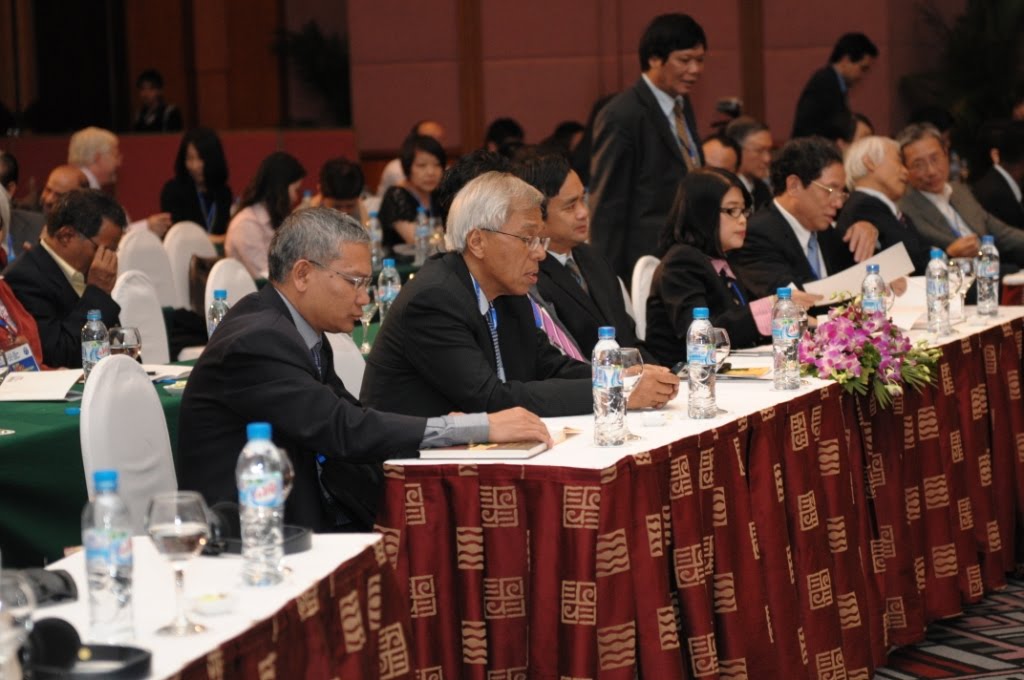
Prof. Mansor (left) and Tan Sri Anuwar Ali among the participants at the conference

The signing ceremony of MOUs between Open University Malaysia, Hanoi Open University, Thailand, Philippines and Indonesia. Picture courtesy of Zulhairi

The proper conference started on the second day on 27th October 2010 at 8.30am. The conference was officially opened by the Deputy Prime Minister of Vietnam, Prof. Nguyen Thien Nham. It was followed by a cultural performance and dragon dance. Five keynote addresses were delivered. Several keynote addresses were also delivered. The highlight of the morning session was the signing of MOUs between Open University Malaysia and Sukhothai Thammathirat Open University of Thailand, Hanoi Open University, Philippines Open University and Universitas Terbuka Indonesia to collaborate on areas of developing programmes.

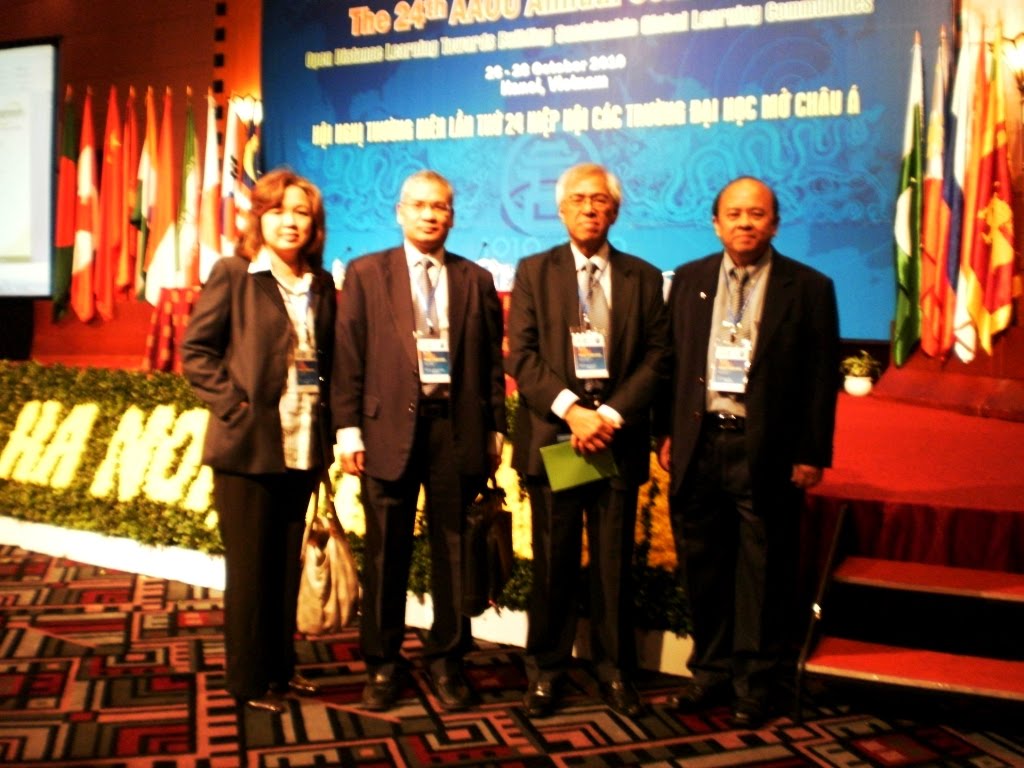
Posing in front of AAOU 2010 backdrop. From left: Prof. Latifah, Prof. Mansor. Tan Sri Anuwar Ali and Richard Ng

In the afternoon the parallel session began where participants presented their papers. Among the presenters from OUM include Prof. Mansor and Dr. Janet Woo.

Prof. Mansor gave a powerful presentation of his paper. Picture courtesy of Zulhairi

Prof. Mansor presented two papers entitled: "Widening Access and Improving Retention in Open and Distance Learning: The Strategies of Open University Malaysia" and "Helping distance learners stay connected: The effectiveness of mobile learning via SMS at Open University Malaysia".

Dr. Janet Woo presenting her shortlisted for Best Paper award paper

Dr. Janet's paper entitled, "Developing Quality Learning Materials for Effective Teaching and Learning in an ODL environment: Making the jump from print modules to online modules", was shortlisted for the best paper award.

Prof. Tan Sri Anuwar Ali delivers his keynote address

On the third day of the conference, on 28th October, 2010, Emeritus Prof. Tan Sri Dr. Anuwar Ali, President and Vice Chancellor of OUM, delivered his keynote address entitled "Going Global: Ensuring Sustainability, Access, Equity and Quality in Open and Distance Learning".

Richard Ng presenting his paper during the conference

In the afternoon, Richard Ng, Director of OUM Perak Learning Centre, presented his paper entitled: "Improving Graduation Rates of Open and Distance Learners via Online Community".

Umi Hanim asking for clarification during the parallel session

The 2-day conference witnessed the participation of over 500 participants from 22 countries. 173 papers were presented under 5 sub-themes. The main theme of the conference was: "OPEN DISTANCE LEARNING TOWARDS BUILDING SUSTAINABLE GLOBAL LEARNING COMMUNITIES".

During the closing ceremony, the outgoing President of AAOU 2010, Prof. Tian Belawati of Indonesia, announced the incoming newly elected AAOU 2011-2013 President, Prof. Wong Tat Meng of Malaysia. Also announced was the winner of the best paper awards and Young Innovators award. The Gold Medal went to Korea, and the two Silver Medals went to the Philippines and Malaysia.

Participants of the AAOU 2010 conference from OUM took the opportunity to visit Ha Long Bay on the final day before departing for Malaysia. The group chartered a boat to take them to visit the mystical mountains which numbered about 2,000. The journey took us almost 3.5 hours to arrive from Hanoi to Ha Long Bay. We spent almost 3 hours at the Ha Long Bay enjoying the scenic beauty and the Heaven Cave located at Ha Long Bay. The weather was good with temperature about 13 degrees Celcius.

Thursday, October 28, 2010

24th AAOU Annual Conference Hanoi Vietnam - Part 1

Prof. Tian Belawati, President of AAOU 2010 delivering her speech

The 24th Asian Association of Open Universities (AAOU) Annual Conference began in Hanoi on 26th Oct 2010. As usual the AAOU board members will hold their annual meeting to discuss any matters arising.

The dragon dance performance during the Opening Ceremony

Honoring the exco members of AAOU

Emeritus Prof. Dr. Anuwar Ali delivering his keynote address

Among the participants from OUM (from left), Prof. Dr. Latifah, Prof. Dr. Mansor Fadzil, Tan Sri Dr. Anuwar Ali and Richard Ng

The AAOU 2010 conference which was held at the Melia Hanoi hotel in Vietnam was officiated by the Deputy Prime Minister of Vietnam, Prof. Nguyen Thien Minh. Earlier, Prof. Dr. Pham Minh Viet, Organizing Chairman of the conference delivered his welcoming address. The opening session was followed by a dragon dance performance. In his speech, Prof. Nguyen hoped that the conference will be able to assist Vietnam in developing its Open and Distance Learning.

Richard Ng with Prof. Pham of Hanoi Open University, the Organizing Chairman of AAOU 2010

Signing of MOU between Open University Malaysia and Open Universities of Thailand, Philippines, Indonesia and Vietnam

Among the keynote speakers invited to speak during the conference include Emeritus Prof. Dr. Anuwar Ali, the President of Open University Malaysia. Others include Prof. Asha Kanwar of Commonwealth of Learning, Emeritus Prof. Gajaraj Dhanarajan of Wawasan Open University, Prof. Jon Baggaley of Athabasca University, Prof. Insung Jung of International Christian University, Prof. Hiromitsu of The Open University of Japan, Prof. Lam of Thang Long University, and Dr. Gatot Hari of SEAMOLEC.

Prof. Mansor presenting his first paper

More than 500 participants from over 20 countries attended the 3-day conference. A total of 173 papers were presented under 5 different sub-themes; Ideology and philosophy; Partnership and Communication; Methodology and Technology; Sustainability, Accessibility,Equity and Quality; and Opportunities and Challenges. The most popular sub-theme is Methodology and Technology with 73 papers.

Recipients of the best paper award: (from left) Gold Medalist - Korea, Silver Medalist - Philippines, Prof. Tian Belawati, President of AAOU, Silver Medalist - Malaysia

Presenters from OUM include Prof. Mansor Fadzil (Senior VP), Prof. Latifah, Dr. Janet Woo Tai Kwan, Richard Ng, and Umi Hanim. Dr. Janet's paper was one of the shortlisted papers for best paper award.

For three consecutive nights, participants were hosted for dinners by Conference Organizer, The Ministry of Education and the Government of Vietnam. The 3-day conference ended on 28 October 2010. During the closing, it was announced that a new president for AAOU has been elected for the period 2011 till 2013.

Prof. Tian Belawati, the outgoing AAOU President from Indonesia (right) passing the AAOU flag to the newly elected AAOU President, Prof. Wong Tat Meng of Malaysia

The handover ceremony was held briefly with the passing of the AAOU flag from the current President Prof. Tian Belawati of Indonesia to Prof. Wong Tat Meng of Malaysia. It was also announced that the next AAOU Conference will be held in Penang in Sept 2011.

Wednesday, October 13, 2010

AMOS Workshop on 23rd Oct 2010 at OUM Main Campus KL

The AMOS workshop has been arranged to assist OUM PhD students understand and use it in their Structural Equation Modeling. Details of the workshop are as follows:

Date: 23 Oct 2010
Time: 9am to 4pm
Venue: OUM Main Campus, KL (Room GA01).
Fee: RM75 per person
Facilitator: Dr Sharifah Faridah Syed Alwi from UM.

Dr. Sharifah's CV can be viewed here.

Fee includes lunch and 2 tea breaks.

As places are very limited, interested participants must register and pay up their fee prior to the start of the workshop. Kindly deposit the registration fee via Chia Bee Ching's Public Bank Account Number: 4706877819 and inform her of your confirmation. Bee Ching can be contacted through 017-3402968.

Tuesday, October 12, 2010

SPSS Workshop on 24th Oct 2010 at OUM Main Campus KL

Attention All PhD Students:

The SPSS class has been arranged for all OUM PhD students. Details are as follows:

Date: 24 Oct 2010
Time: 9am - 4pm
Venue: Room GA01, OUM Main Campus
Facilitator: Assoc. Prof. Dr. Bahaman Abu Samah from UPM
Fee: RM75 per person.

The workshop will be conducted using hands-on approach.

Assoc. Prof. Dr. Bahaman's details can be found here. He has been teaching Statistics & Advanced Statistics for Social Science since 1997.

As places are very limited, interested participants must register and pay up their fee prior to the start of the workshop. Kindly deposit the registration fee via Chia Bee Ching's Public Bank Account Number: 4706877819 and inform her of your confirmation. Bee Ching can be contacted through 017-3402968.

Monday, October 11, 2010

PhD Viva for First Batch of OUM Students

PhD Candidate, Richard Ng, with his supervisor, Prof. Karl Wagner during the viva-voce held on Sept 2 at OUM Main Campus

The first batch of PhD (Business Administration) students had their Viva-Voce set beginning September 2 to September 29 2010. Among the first candidate to attend the Viva was Richard Ng, who started his PhD journey in September 2005. It was then followed by Lum Heap Sum, Wong Siaw Ming and Patrick Wong.


The Viva-Voce process is the final stage of a PhD candidates' journey before they can be called "Doctor". It was conducted within 3 months after candidates have submitted their final thesis.

Richard Ng presenting his research in front of the panel of examiners

At OUM, three examiners (2 external and 1 internal) will examine the theses of a candidate. The viva was then fixed where the candidate will give a short presentation of approximately 20 to 30 minutes. Candidates will then be asked on why they choose their research topic, what is the objective of the research and how he is going about with it. Candidates will also be asked on their literature reviews and theories supporting their research. They will also need to explain their conceptual model and how they derive at it.

Richard Ng answering questions posted by the panel

Examiners are keen to find out the methodology used and how the research findings are analysed, aspect of validity and reliability of data and what is the outcome of their research and how it can contribute to the body of knowledge.

The viva-voce normally takes about 2 hours in all. At the end of the session, candidates will be informed about the decisions of the panel. Decisions could range from minor correction (usually within 1 month), major correction (within 6 months), to redo (within 12 months) or outright failure.

All the four candidates mentioned above who have had their viva-voce in September 2010, have passed their viva with minor or major correction. Candidates will then need to respond to the panel's proposal for correction and submit within the time frame given.

Once the corrections have been submitted, a reviewer (not necessary the same examiner) will review the amendment submitted. Once all the suggestions have been fulfilled the Chairperson of the panel will approve it and submit for confirmation to the academic board of OUM before it is endorsed by the senate. Upon endorsement of senate, the candidate can use the "doctor" title in front of their names.

Thursday, September 16, 2010

PhD Students Informal Gathering on Sept 26, 2010

Posted by Bee Ching


Dear all,

After discussing with Dr Rosmah, we have come up with the tentative program for Sept 26 as follows:

9.00am - 9.30am

Presentation by Steven Tan (he passed his QE in year on his Post QE research progress

9.30am - 10.00am

Questions and answers

10.00am - 10.40am

Tea break cum HARI RAYA AIDILFITRI celebration

10.40am - 11.45am

Talk by Dr Rosmah on her PhD journey

12.00pm - 1.00pm

PhD(BA) Discussion Free Flow - where and how we like to go from here, including contents of AMOS and SPSS on 23rd and 24th October.

Regarding the scheduled workshops ,after email replies ,some telephone calls and SMS feedback, we have the following responses , 11 persons chose option 1(2 days) , 2 persons chose option 1 (Amos), 6 chose option 2(SPSS) .5 replies not coming as they are not free or they are doing qualitative research. The others are yet to reply. To help those who need to make travel arrangement, hence, the tentative time and cost for the October workshops are as follows:

23th Oct 9-4pm with 1 hour lunch break AMOS (contents will follow)
24th Oct 9-4pm with l hour lunch break SPSS (contents will follow)

Cost for workshop RM75.00 per day including lunch and two tea breaks

Hence for those who choose to come for l day workshop ,need to pay RM75.00 and for those chose to come for 2 days RM150.00.

In order to reduce the organizing committee workload and ease of account budgeting, we would like the confirmed participants to make payment in advance.

As a suggestion, as many of us are coming for the 26th Sept get together discussion meeting ,they are welcome to make the payments then. Otherwise, please bank into my Public Bank account Chia Bee Ching No: 4706877819 the full amount upon confirmation of attendance of workshops and inform vie mobile 0173402968 or email.

Thank you
beeching chia .

Saturday, September 4, 2010

Deduction & Induction

By William M. K. Trochim

In logic, we often refer to the two broad methods of reasoning as the deductive and inductive approaches.


Deductive reasoning works from the more general to the more specific. Sometimes this is informally called a "top-down" approach. We might begin with thinking up a theory about our topic of interest. We then narrow that down into more specific hypotheses that we can test. We narrow down even further when we collect observations to address the hypotheses. This ultimately leads us to be able to test the hypotheses with specific data -- a confirmation (or not) of our original theories.


Inductive reasoning works the other way, moving from specific observations to broader generalizations and theories. Informally, we sometimes call this a "bottom up" approach (please note that it's "bottom up" and not "bottoms up" which is the kind of thing the bartender says to customers when he's trying to close for the night!). In inductive reasoning, we begin with specific observations and measures, begin to detect patterns and regularities, formulate some tentative hypotheses that we can explore, and finally end up developing some general conclusions or theories.

These two methods of reasoning have a very different "feel" to them when you're conducting research. Inductive reasoning, by its very nature, is more open-ended and exploratory, especially at the beginning. Deductive reasoning is more narrow in nature and is concerned with testing or confirming hypotheses. Even though a particular study may look like it's purely deductive (e.g., an experiment designed to test the hypothesized effects of some treatment on some outcome), most social research involves both inductive and deductive reasoning processes at some time in the project. In fact, it doesn't take a rocket scientist to see that we could assemble the two graphs above into a single circular one that continually cycles from theories down to observations and back up again to theories. Even in the most constrained experiment, the researchers may observe patterns in the data that lead them to develop new theories.

Details at: http://www.socialresearchmethods.net/kb/dedind.php