Friday, December 30, 2011

The disposable academic - Why doing a PhD is often a waste of time - The Economist


ON THE evening before All Saints’ Day in 1517, Martin Luther nailed 95 theses to the door of a church in Wittenberg. In those days a thesis was simply a position one wanted to argue. Luther, an Augustinian friar, asserted that Christians could not buy their way to heaven. Today a doctoral thesis is both an idea and an account of a period of original research. Writing one is the aim of the hundreds of thousands of students who embark on a doctorate of philosophy (PhD) every year.

In most countries a PhD is a basic requirement for a career in academia. It is an introduction to the world of independent research—a kind of intellectual masterpiece, created by an apprentice in close collaboration with a supervisor. The requirements to complete one vary enormously between countries, universities and even subjects. Some students will first have to spend two years working on a master’s degree or diploma. Some will receive a stipend; others will pay their own way. Some PhDs involve only research, some require classes and examinations and some require the student to teach undergraduates. A thesis can be dozens of pages in mathematics, or many hundreds in history. As a result, newly minted PhDs can be as young as their early 20s or world-weary forty-somethings.

One thing many PhD students have in common is dissatisfaction. Some describe their work as “slave labour”. Seven-day weeks, ten-hour days, low pay and uncertain prospects are widespread. You know you are a graduate student, goes one quip, when your office is better decorated than your home and you have a favourite flavour of instant noodle. “It isn’t graduate school itself that is discouraging,” says one student, who confesses to rather enjoying the hunt for free pizza. “What’s discouraging is realising the end point has been yanked out of reach.”

Whining PhD students are nothing new, but there seem to be genuine problems with the system that produces research doctorates (the practical “professional doctorates” in fields such as law, business and medicine have a more obvious value). There is an oversupply of PhDs. Although a doctorate is designed as training for a job in academia, the number of PhD positions is unrelated to the number of job openings. Meanwhile, business leaders complain about shortages of high-level skills, suggesting PhDs are not teaching the right things. The fiercest critics compare research doctorates to Ponzi or pyramid schemes.

Rich pickings


For most of history even a first degree at a university was the privilege of a rich few, and many academic staff did not hold doctorates. But as higher education expanded after the second world war, so did the expectation that lecturers would hold advanced degrees. American universities geared up first: by 1970 America was producing just under a third of the world’s university students and half of its science and technology PhDs (at that time it had only 6% of the global population). Since then America’s annual output of PhDs has doubled, to 64,000.

Other countries are catching up. Between 1998 and 2006 the number of doctorates handed out in all OECD countries grew by 40%, compared with 22% for America. PhD production sped up most dramatically in Mexico, Portugal, Italy and Slovakia. Even Japan, where the number of young people is shrinking, churned out about 46% more PhDs. Part of that growth reflects the expansion of university education outside America. Richard Freeman, a labour economist at Harvard University, says that by 2006 America was enrolling just 12% of the world’s students.

But universities have discovered that PhD students are cheap, highly motivated and disposable labour. With more PhD students they can do more research, and in some countries more teaching, with less money. A graduate assistant at Yale might earn $20,000 a year for nine months of teaching. The average pay of full professors in America was $109,000 in 2009—higher than the average for judges and magistrates.

Indeed, the production of PhDs has far outstripped demand for university lecturers. In a recent book, Andrew Hacker and Claudia Dreifus, an academic and a journalist, report that America produced more than 100,000 doctoral degrees between 2005 and 2009. In the same period there were just 16,000 new professorships. Using PhD students to do much of the undergraduate teaching cuts the number of full-time jobs. Even in Canada, where the output of PhD graduates has grown relatively modestly, universities conferred 4,800 doctorate degrees in 2007 but hired just 2,616 new full-time professors. Only a few fast-developing countries, such as Brazil and China, now seem short of PhDs.

A short course in supply and demand

In research the story is similar. PhD students and contract staff known as “postdocs”, described by one student as “the ugly underbelly of academia”, do much of the research these days. There is a glut of postdocs too. Dr Freeman concluded from pre-2000 data that if American faculty jobs in the life sciences were increasing at 5% a year, just 20% of students would land one. In Canada 80% of postdocs earn $38,600 or less per year before tax—the average salary of a construction worker. The rise of the postdoc has created another obstacle on the way to an academic post. In some areas five years as a postdoc is now a prerequisite for landing a secure full-time job.

These armies of low-paid PhD researchers and postdocs boost universities’, and therefore countries’, research capacity. Yet that is not always a good thing. Brilliant, well-trained minds can go to waste when fashions change. The post-Sputnik era drove the rapid growth in PhD physicists that came to an abrupt halt as the Vietnam war drained the science budget. Brian Schwartz, a professor of physics at the City University of New York, says that in the 1970s as many as 5,000 physicists had to find jobs in other areas.

In America the rise of PhD teachers’ unions reflects the breakdown of an implicit contract between universities and PhD students: crummy pay now for a good academic job later. Student teachers in public universities such as the University of Wisconsin-Madison formed unions as early as the 1960s, but the pace of unionisation has increased recently. Unions are now spreading to private universities; though Yale and Cornell, where university administrators and some faculty argue that PhD students who teach are not workers but apprentices, have resisted union drives. In 2002 New York University was the first private university to recognise a PhD teachers’ union, but stopped negotiating with it three years later.

In some countries, such as Britain and America, poor pay and job prospects are reflected in the number of foreign-born PhD students. Dr Freeman estimates that in 1966 only 23% of science and engineering PhDs in America were awarded to students born outside the country. By 2006 that proportion had increased to 48%. Foreign students tend to tolerate poorer working conditions, and the supply of cheap, brilliant, foreign labour also keeps wages down.

Proponents of the PhD argue that it is worthwhile even if it does not lead to permanent academic employment. Not every student embarks on a PhD wanting a university career and many move successfully into private-sector jobs in, for instance, industrial research. That is true; but drop-out rates suggest that many students become dispirited. In America only 57% of doctoral students will have a PhD ten years after their first date of enrolment. In the humanities, where most students pay for their own PhDs, the figure is 49%. Worse still, whereas in other subject areas students tend to jump ship in the early years, in the humanities they cling like limpets before eventually falling off. And these students started out as the academic cream of the nation. Research at one American university found that those who finish are no cleverer than those who do not. Poor supervision, bad job prospects or lack of money cause them to run out of steam.

Even graduates who find work outside universities may not fare all that well. PhD courses are so specialised that university careers offices struggle to assist graduates looking for jobs, and supervisors tend to have little interest in students who are leaving academia. One OECD study shows that five years after receiving their degrees, more than 60% of PhDs in Slovakia and more than 45% in Belgium, the Czech Republic, Germany and Spain were still on temporary contracts. Many were postdocs. About one-third of Austria’s PhD graduates take jobs unrelated to their degrees. In Germany 13% of all PhD graduates end up in lowly occupations. In the Netherlands the proportion is 21%.

A very slim premium

PhD graduates do at least earn more than those with a bachelor’s degree. A study in the Journal of Higher Education Policy and Management by Bernard Casey shows that British men with a bachelor’s degree earn 14% more than those who could have gone to university but chose not to. The earnings premium for a PhD is 26%. But the premium for a master’s degree, which can be accomplished in as little as one year, is almost as high, at 23%. In some subjects the premium for a PhD vanishes entirely. PhDs in maths and computing, social sciences and languages earn no more than those with master’s degrees. The premium for a PhD is actually smaller than for a master’s degree in engineering and technology, architecture and education. Only in medicine, other sciences, and business and financial studies is it high enough to be worthwhile. Over all subjects, a PhD commands only a 3% premium over a master’s degree.

Dr Schwartz, the New York physicist, says the skills learned in the course of a PhD can be readily acquired through much shorter courses. Thirty years ago, he says, Wall Street firms realised that some physicists could work out differential equations and recruited them to become “quants”, analysts and traders. Today several short courses offer the advanced maths useful for finance. “A PhD physicist with one course on differential equations is not competitive,” says Dr Schwartz.

Many students say they are pursuing their subject out of love, and that education is an end in itself. Some give little thought to where the qualification might lead. In one study of British PhD graduates, about a third admitted that they were doing their doctorate partly to go on being a student, or put off job hunting. Nearly half of engineering students admitted to this. Scientists can easily get stipends, and therefore drift into doing a PhD. But there are penalties, as well as benefits, to staying at university. Workers with “surplus schooling”—more education than a job requires—are likely to be less satisfied, less productive and more likely to say they are going to leave their jobs.

Academics tend to regard asking whether a PhD is worthwhile as analogous to wondering whether there is too much art or culture in the world. They believe that knowledge spills from universities into society, making it more productive and healthier. That may well be true; but doing a PhD may still be a bad choice for an individual.

The interests of academics and universities on the one hand and PhD students on the other are not well aligned. The more bright students stay at universities, the better it is for academics. Postgraduate students bring in grants and beef up their supervisors’ publication records. Academics pick bright undergraduate students and groom them as potential graduate students. It isn’t in their interests to turn the smart kids away, at least at the beginning. One female student spoke of being told of glowing opportunities at the outset, but after seven years of hard slog she was fobbed off with a joke about finding a rich husband.

Monica Harris, a professor of psychology at the University of Kentucky, is a rare exception. She believes that too many PhDs are being produced, and has stopped admitting them. But such unilateral academic birth control is rare. One Ivy-League president, asked recently about PhD oversupply, said that if the top universities cut back others will step in to offer them instead.

Noble pursuits

Many of the drawbacks of doing a PhD are well known. Your correspondent was aware of them over a decade ago while she slogged through a largely pointless PhD in theoretical ecology. As Europeans try to harmonise higher education, some institutions are pushing the more structured learning that comes with an American PhD.

The organisations that pay for research have realised that many PhDs find it tough to transfer their skills into the job market. Writing lab reports, giving academic presentations and conducting six-month literature reviews can be surprisingly unhelpful in a world where technical knowledge has to be assimilated quickly and presented simply to a wide audience. Some universities are now offering their PhD students training in soft skills such as communication and teamwork that may be useful in the labour market. In Britain a four-year NewRoutePhD claims to develop just such skills in graduates.

Measurements and incentives might be changed, too. Some university departments and academics regard numbers of PhD graduates as an indicator of success and compete to produce more. For the students, a measure of how quickly those students get a permanent job, and what they earn, would be more useful. Where penalties are levied on academics who allow PhDs to overrun, the number of students who complete rises abruptly, suggesting that students were previously allowed to fester.

Many of those who embark on a PhD are the smartest in their class and will have been the best at everything they have done. They will have amassed awards and prizes. As this year’s new crop of graduate students bounce into their research, few will be willing to accept that the system they are entering could be designed for the benefit of others, that even hard work and brilliance may well not be enough to succeed, and that they would be better off doing something else. They might use their research skills to look harder at the lot of the disposable academic. Someone should write a thesis about that.

Source: http://www.economist.com/node/17723223?fsrc=scn/tw/te/mp/thedisposableacademic

Tuesday, December 13, 2011

Majlis Konvokesyen ke 11 OUM pada 10 & 11 Disember 2011

Cokmar OUM diletakkan dengan berhati-hati sebelum Majlis Konvokesyen di mulakan

Ucapan aluan Presiden dan Naib Canselor OUM, YBhg Prof Emeritus Tan Sri Dr. Anuwar Ali

Seramai 3,468 orang graduan menerima ijazah masing-masing pada Majlis Konvokesyen OUM yang ke 11 yang telah dijalankan dari 10 hingga 11 Disember 2011. Mereka menerima ijazah daripada YAB Tun Jeanne Abdullah, Canselor OUM pada hari pertama dan YBhg Tan Sri Azman Hashim, Pro-Canselor OUM pada hari kedua.

YBhg Prof Emeritus Tan Sri Dr. Anuwar Ali sedang membacakan latar belakang YBhg Tan Sri Arshad Ayub yang dikurniakan dengan Ijazah Doktor Kehormat Pengurusan

YBhg Tan Sri Arshad Ayub sedang menerima Ijazah Doktor Kehormat dari YABhg Tun Jeanne Abdullah, Canselor OUM

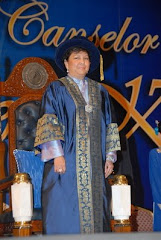
YABhg Tun Jeanne Abdullah, Canselor OUM sedang mengishtiharkan pembukaan Majlis Kovokesyen OUM ke11

Majlis ini telah dijalankan di Dewan Merdeka PWTC seperti konvokesyen yang lepas. Para graduan hadir bersama keluarga masing-masing membanjiri PWTC pada tingkat 4 di mana majlis ini dilangsungkan.

Dr. Siti Mazidah, graduan PhD (Pendidikan) sedang menyampaikan ucap terima kasih bagi pihak graduan

Salah seorang graduan sedang menerima ijazahnya dari YABhg Tun Canselor pada hari konvo pertama

Majlis dimulakan dengan perarakan akademik dan perarakan besar. Selepas itu lagu NegaraKu diikuti lagu OUM dimainkan.

Presiden dan Naib Canselor OUM memulakan majlis dengan ucapan aluan serta memohon izin Canselor untuk menganugerahkan ijazah-ijazah kepada para graduan.

Para graduan berdiri semasa perarakan akademik

Pada majlis kali ini, 3 orang graduan PhD dalam pendidikan berjaya menerima ijazah mereka. Antaranya ialah Dr. Siti Maziha yang telah diberi penghormatan untuk menyampaikan ucapan bagi pihak para graduan sekalian.

Kelihatan graduan sedang senyum lebar menandakan saat kegembiraan mereka

Terdahulu dari itu, YBhg Tan Sri Dato Arshad Ayub telah dianugerahkan Ijazah Kedoktoran Kehormat dalam bidang pengurusan bagi mengenang jasanya dalam bidang pendidikan jarak jauh.

Salah seorang graduan sedang menerima ijazahnya dari YBhg Tan Sri Azman Hashim Pro-Canselor OUM pada hari konvo kedua

Barisan ahli akademik sedang menanti saat untuk perarakan masuk akademik

Dr. Rosmah bersama Dr. Richard semasa majlis konvo

Majlis konvokesyen ini telah dijalankan dalam empat sidang dengan dua sidang setiap hari.

Para graduan sedang membetulkan jubah masing-masing sebelum majlis konvo

Para graduan sedang sibuk membeli ole-ole OUM di kaunter Alumni OUM

Thursday, November 10, 2011

More than 60% of private colleges in Malaysia ranked as satisfactory - The Star

By ALYCIA LIM

PUTRAJAYA: More than 60% of private colleges in Malaysia have been ranked as satisfactory, according to the first Malaysia Quality Evaluation System (MyQUEST), with a score of four stars and above.

Higher Education Minister Datuk Seri Mohamed Khaled Nordin said of a total of 403 colleges, 232 were qualified to be audited based on the criterias set by the ministry but only 210 agreed to be audited.

"The purpose of MyQUEST is to categorise the colleges which are excellent, good, or weak, and prepare the suitable approaches to help the weaker ones with their issues and challenges,” said Khaled at a press conference after the ministry's Integrity Day 2011 celebration here Thursday.

Of all the colleges, only three institutions - Penang Medical College, Segi College Subang Jaya and Taylor's College Subang Jaya were awarded the maximum of six stars.

Mohamed Khaled urged private colleges to continuously improve their quality and performance to remain competitive in the market and encouraged those that were eligible to participate in the evaluation system.

"If the colleges are genuine and confident, I do not see any reason why they would not want to participate."

He said the system would also help the public with deciding where they wanted to pursue their tertiary education.

"If a college is continuously ranked below three stars, the market would decide their fate," he said, adding that the ranking would act as a reference point for PTPTN loan approvals and requests to be upgraded to a University College status, among others.

Apart from the top three colleges, 20 colleges (9.5%) attained five stars, and 60 colleges (28.6%) attained four stars, with the remaining 72 (34.3%) receiving three stars and below

Thursday, November 3, 2011

Using A Light Barrier To Repel Mosquitoes - Forbes

Columbia physicist Szabolcs Marka


What if it turned out that you could ditch the bug spray to keep mosquitoes away –and use a beam of light instead? That’s what Szabolcs Márka, an experimental physicist, is in the early stages of researching.

Márka, 42, an associate professor at Columbia University, is an academic who lets his curiosity lead him. He had been studying optics as part of his astrophysics research (on what happens when two black holes merge) several years ago when the idea popped into his head that mosquitoes find their targets using complex sensory systems, so what about damaging or confusing those sensors? Working with colleagues including his wife associate research scientist Zsuzsa Márka (a physicist and a chemist) and Imre Bartos (an astrophysicist), he first tried knocking out and damaging the sensors of Anopheles gambiae, a malaria mosquito. Then the researchers came up with the idea of a light barrier. “We stumbled on this: If you have an invisible wall of light, how will mosquitoes and fruit flies react? They do walk or fly into it. Then they turn back. They don’t want to cross it,” says Márka. (Watch this video here to see how the mosquitoes stop at the invisible wall of light.)

He applied to the Bill & Melinda Gates Foundation and got a $100,000 grant in 2008 to pursue the research. His results were so interesting that the Gates Foundation gave him a second grant, of $1 million, to keep going. His is just one of five research groups to receive a second grant as a follow up to the foundation’s Grand Challenges Explorations grants.

The Gates Foundations’ primary interest in this research is its possible use for preventing malaria. Despite successful efforts to reduce the incidence of the disease in some countries, malaria still kills nearly 1 million people a year –mostly in sub Saharan Africa and mostly children under age 5. But the applications could be much wider. Imagine beams of light in your backyard patio keeping the bugs away — or a beam across your bedroom window, keeping the mosquitoes from entering your room.

Márka says it will be years before real practical tools emerge. Right now, his team is using the Gates Foundation grant to study the parameters of the effect they discovered. Does this apply to old mosquitoes as well as young ones? Does it work on mosquitoes that are well fed as well as those who are not? Is the best beam of light one by a window, or encircling a bed? They are also developing a mathematical model that will predict the broader effects of this tool. If you protect 50% of the people from mosquitoes, will it make the situation worse for the other 50%?

Just why the mosquitoes are repelled by the light barrier is a mystery Márka and his colleagues are still trying to unravel. “For practical purposes, it doesn’t really matter why. When I put on my scientist hat, this is the most interesting question,” says Márka. If scientists can understand how a mosquito identifies odors and gases and finds the right place to bite, Márka envisions one day creating robots with these qualities. “Imagine someone is down in a mine –we don’t want to go there. Or there’s a wounded soldier. Or there’s a person trapped close to a nuclear reactor,” he says, describing the opportunities for robots that can find humans the way mosquitoes and other arthropods do.

His insect research on the surface looks like quite a leap from previous projects in fundamental science. Márka, who is from Hungary but got his PhD at Vanderbilt University, was a nuclear physicist and spent time characterizing materials that could make nuclear reactors safer. Then he switched to particle physics and worked on building and using particle detectors destined to figure out aspects of how quarks behave. As the leader of the experimental gravity group at Columbia, he is looking into what happens when two black holes or neutron stars merge in the distant universe, is collaborating with the Laser Interferometer Gravitational Wave Observatory, a facility funded by the National Science Foundation and located in Louisiana and Hanford, Wash. that aims to detect cosmic gravitational waves Márka describes it as an instrument that “takes a light beam, splits it into two parts, brings them back together and measures whether one traveled longer than the other.” The purpose? “It’s opening a new window on the universe. You could see wonderful processes through gravitational waves—figuratively speaking, ‘the ripples of space-time itself’ –that you do not see otherwise.”

Prof. Márka’s work has earned him a spot as a finalist for the Blavatnik Award for Young Scientists, given out under the auspices of the New York Academy of Sciences and backed by Russian-American billionaire industrialist Len Blavatnik. The winner of the Blavatnik Award will be announced on Nov. 14.

Wednesday, October 12, 2011

OUM PhD Students Monthly Gathering - Oct 23, 2011

Posted by Bee Ching:

Dear All,

We live in a multi-racial, multi cultural and multi-religious society. Last month,our Muslim friends celebrated Hari Raya Aidilfitri , this month we will have our Indian friends celebrate their Deepavali festival on the 26th of October. Hence the normal scheduled last Sunday meeting has been put forward a week early to 23rd as to allow members to enjoy the festival of light without interruption.

October meeting, we are glad to invite our ex-Doctoral Seminar facilitator and now Director of Student Management Center, Assoc Prof Dr Santhi Raghavan to give a Talk on Developing and Administrating of Survey Questionnaires.

We are looking forward to listen to Dr Santhi's timely expert guidance on how ,where, what and which survey questionnaires are to be selected, adapted and adopted for our research proposal.

Besides the Talk, we have invited our first batch of pioneer PhD(BA) graduates Richard Ng, Lum Heap Sum,Wong Siaw Ming and Patrick Wong to come and join us and share their(lonely) research journeys with us.

At the point of writing this message, Dr Richard Ng, has replied he would be working on the day . Dr Lum and Dr Wong Siaw Ming have just replied that they would be happy to join us. As suggested by Zulkifli, during our dialogue session, we hope to listen to some mentoring tips from Dr Lum and Dr Wong. They said they would be happy to answer questions raised from the floor. Please have your questions ready.

By the way, I have forwarded three files on PhD September briefings prepared by Dr Rosmah to members in the loop. I realized the file size is very large and many mails sent to members' company addresses have been returned and have to be resent again twice to limit the files size. Please download the 50 ppf slides, and keep the information for future reference. The one on Estimated to complete PhD time table is most useful .

Below please find the 23rd October Program Agenda

9.00-9.30 - Registration
9,30-10.30 - Developing and administrating survey questionnaire( Part 1)
10.30-11.00 - Morning tea break
11.00-12.00 - Developing and administrating survey questionnaire( Part 2)
12.00-1.00 - Sharing by Dr Lum and Dr Wong .
1.00-2.30 - Lunch

Venue : GA01 Beside Theatrette & Library, OUM

Cost : nil

For those intending to come, please confirm by email to cbeching@yahoo.com or
sms to 0173402968 so that Dr Santhi will know the number of notes to be prepared as well as the lunch to be ordered

Thank you and see you all there to listen, to learn, to meet and to network.

Happy studying and writing

Tuesday, October 11, 2011

Post-grad student boost - The Star

KUALA LUMPUR: Students will have a chance to continue their studies at international institutions through the newly-launched Merdeka Award Grant for International Attachment, Datuk Seri Najib Tun Razak said.

The Prime Minister said the grant, open to Malaysian post-graduate students between 22 and 35 years old, would be introduced next year in disciplines like education, arts, sports, community and social work, environment, health, and science and technology.

“The youths are our future and it is important that we guide and provide them the opportunities and facilities to pursue their interest,” he said at the Merdeka Award ceremony at Dewan Filharmonik Petronas here last night.

The grant will allow students to engage in short-term collaborative projects at selected, internationally-recognised host institutions to develop their expertise.

“One grant will be offered in 2012 and two each in subsequent years,” he added.

At the function, Najib presented awards to Datuk Dr Kenneth Yeang, Prof Datuk Dr Goh Khean Lee and Prof Dr Mak Joon Wah for outstanding work in their respective fields.

Yeang received an award in the environment category for his contributions to developing ecology-related designs for buildings and in environmental conservation planning while Dr Goh and Dr Mak were joint recipients in the Outstanding Scholastic Achievement category.

Dr Goh was awarded for his contributions to developing research and practices in gastroenterology and hepatology in Malaysia to the global level.

Dr Mak is recognised as a global expert on filariasis and malaria by the World Health Organisation after being appointed consultant in at least 17 different cases.

Dr Goh said: “It is an honour to be chosen and I am extremely happy to share this prestigious award with a well-known scholar like Dr Mak.”

Each category offers a RM500,000 prize money, a trophy and a certificate.

The joint recipients of the Outstanding Scholastic Achievement category will share the award equally.

Also present at the ceremony were previous Merdeka Award recipients, the Prime Minister's wife Datin Seri Rosmah Mansor and Merdeka Award Board of Trustees chairman Datuk Shamsul Azhar Abbas

The Merdeka Award was established by Petronas, ExxonMobil and Shell on August 27, 2007 to recognise and reward individuals who had made outstanding and lasting contributions to the nation in their respective fields.

Khaled: Local unis missing THE 400 research criteria - The Malaysian Insider


KUALA LUMPUR, Oct 10 — Local universities did not feature in the recent Times Higher Education (THE) World University Rankings as they lacked the research expertise needed for a placing, Higher Education Minister Datuk Seri Mohamad Khaled Nordin explained today.
“We know that if we participated, we will not even make it into the Times top 400 university rankings because we are new, we need to wait until our research really matured,” Khaled was quoted by Bernama Online today.

“It’s not that we have been assessed and disqualified... [but] our elements of research are just too young and immature [to make the list].”


Times’ World University Rankings is a grades the world’s top 400 universities.

The California Institute of Technology — or Caltech — secured top spot in this year’s rankings, followed by Harvard, Stanford, Oxford, Princeton.

The World University Rankings first appeared as a supplement in The Times of London, are now published by the Times Higher Education magazine.

The weekly is regarded as the UK’s leading higher education publication.